
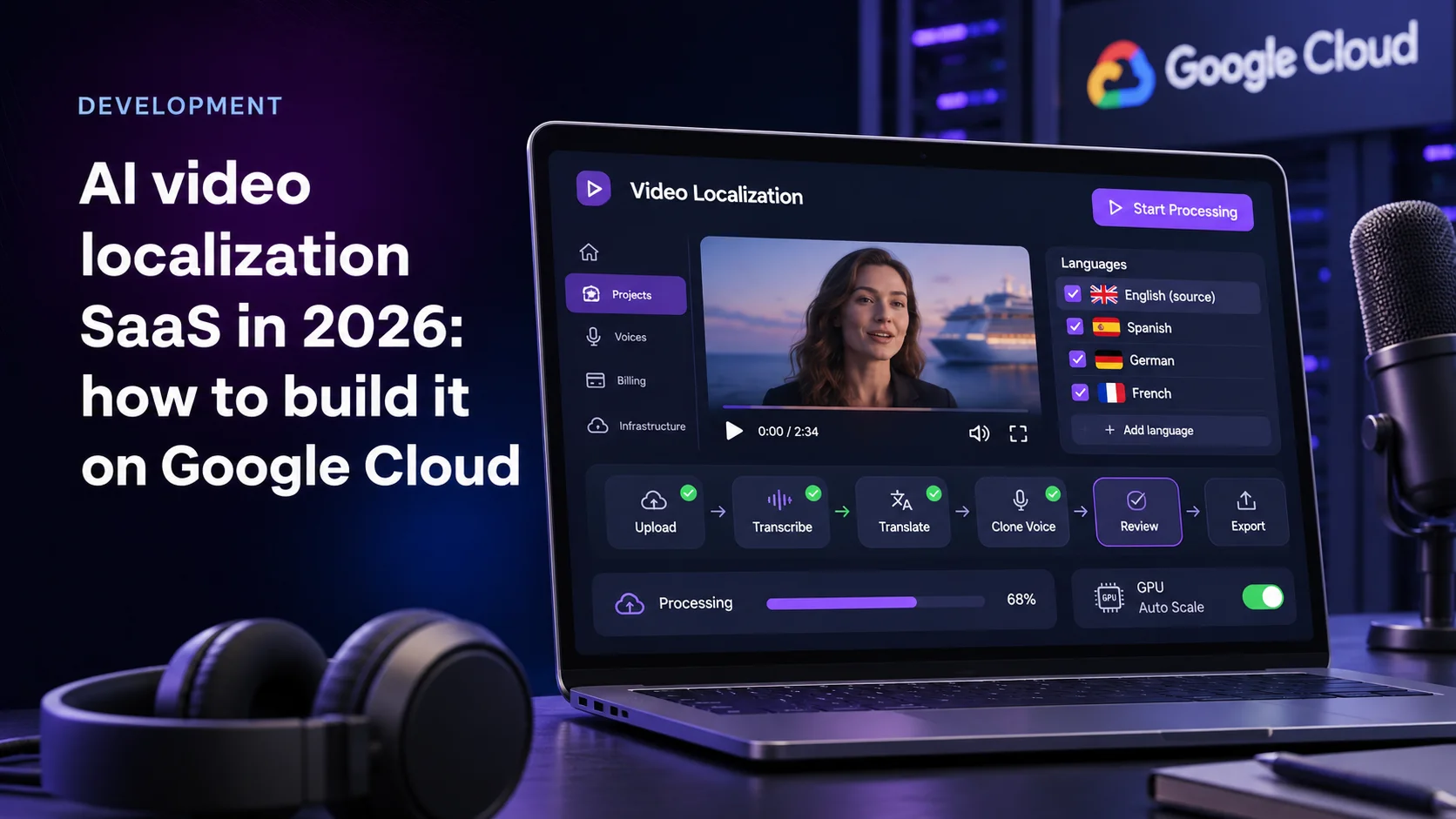
AI video localization SaaS in 2026: how to build it on Google Cloud
TL;DR
An AI video localization SaaS in 2026 is a pipeline more than a model: it ingests 5-20GB source files, clones voices, puts every dub through review, bills by the minute and scales GPUs on demand. This guide walks that build on Google Cloud, layer by layer.
- Cloud Run caps HTTP/1 requests at 32 MiB, so large uploads go straight to Cloud Storage over resumable sessions that stay valid for up to a week.
- Instant voice clones want 1-2 minutes of clean, single-speaker audio. Plan for distorted output in version one.
- The Wav2Lip repository forbids commercial use of its models. Lip sync is R&D, not a sprint ticket.
- YouTube's Developer Policies bar downloading videos and applying alternate audio tracks through the API.
- Stripe credit grants apply only to metered prices, which fits per-minute billing.
Creators want reach, and YouTube's own dubs stop short
A creator has valuable content and cannot reach people who do not speak the language. YouTube answered part of that. On December 10, 2024, the YouTube Blog opened auto dubbing to hundreds of thousands of Partner Program channels focused on knowledge and information, and warned that the dubbed voice may not accurately represent the original speaker. The current auto dubbing help page lists the gaps a paid product can fill: videos over 120 minutes are not eligible, and you cannot edit automatic dubs.
Uploaded dubs are where the money sits. YouTube's multi-language audio page says creators who added their own tracks saw over 25% of their watch time come from views in the video's non-primary language. YouTube publishes no method for that figure. Your SaaS produces those tracks, with a reviewer in the loop.
November 2026 changed the YouTube upload rules, not the audio rules
YouTube's Data API revision history records that from November 2, 2026, videos uploaded through videos.insert from unverified API projects are no longer restricted to private viewing mode. Direct publishing got easier.
The audio rules did not move. The Developer Policies, last updated November 6, 2026, still say API clients must not download, cache or store copies of YouTube audiovisual content without prior written approval. They also forbid separating or modifying the audio of YouTube content, with an explicit example: you must not apply alternate audio tracks to videos. The videos.insert reference caps uploads at 100 calls per day per project.
The two features founders ask for first, paste a YouTube link and push the dub back as a track, both collide with policy.
How we put this guide together
Ask an AI assistant how to build a video localization product and you get tool comparisons or vendor pages: the ElevenLabs dubbing API guide and CAMB.AI's library automation guide each explain their own API and carry six FAQ entries. An AWS reference pipeline from December 2024 runs on AWS, not Google Cloud.
In November 2026 we read the documentation cited below. The product risks come from Mercury's presales review of a real localization brief, described without the client's name. Mercury Development builds products like this, so read this as an interested view. For mobile capture, see our video editing app guide.
The localization pipeline at a glance
| Stage | Google Cloud piece | What breaks first |
|---|---|---|
| Ingest | Cloud Storage resumable upload | App server request limits |
| Speech and translation | Batch jobs on Cloud Run | Speaker mix-ups on group shots |
| Voice | Voice cloning API or own model | Distorted clones from noisy audio |
| Lip sync | GPU job, optional | Blur and licensing |
| Review | Admin queue in your web app | Dubs shipped unchecked |
| Delivery | Download, or upload with user consent | YouTube API policy |
| Billing | Stripe meters and credit grants | Charging for failed jobs |
Uploads of 5 to 20GB: keep them away from your app server
A 500MB upload cap looks sane in a spec and fails on the first real creator file.
The Cloud Run quotas page lists a 32 MiB maximum for HTTP/1 requests, so a multi-gigabyte file can never pass through your API. The browser uploads directly to Cloud Storage instead:
- Your API checks the user's plan and creates a resumable upload session. Each session stays active for up to a week, so a dropped connection or a closed laptop resumes instead of restarting.
- The client sends chunks in multiples of 256 KiB.
- A storage event starts processing only when the object is complete.
Cloud Storage allows objects up to 5 TiB, and V4 signed URLs for one-off links live at most 7 days.
Vendor APIs have their own caps: the ElevenLabs dubbing endpoint accepts files of at most 3 GiB. Extract the audio track and a low-bitrate proxy, keep the master in your bucket, and render the final mux yourself.
Voice-clone quality in version one
Early clones sound wrong more often than founders expect, and the cause is usually the input.
ElevenLabs' voice cloning guide recommends 1-2 minutes of good audio for an instant clone, with one speaker and no background noise. Google's Chirp 3 Instant Custom Voice works from about 10 seconds of reference audio, but access is restricted to allow-listed users, and the speaker must record a fixed consent statement.
A creator video breaks all of that: music under speech, two hosts, street noise. So protect the clone:
- Separate speech from music before cloning, and keep the music stem for the final mix.
- Diarize speakers and cut a clean sample per voice.
- Score each clone and fall back to a stock voice when the score is low.
- Record consent per voice, even when the vendor does not ask.
Treat lip sync as an R&D track
The Wav2Lip paper, published at ACM Multimedia 2020, says its morphed regions are sometimes slightly blurry or carry slight artifacts, and that lip-syncing TTS speech has room for improvement. That is your exact use case.
Licensing closes the shortcut. The Wav2Lip repository states that any form of commercial use is strictly prohibited, because the models were trained on the LRS2 dataset. The AWS reference pipeline used Video-Retalking for the same step. Even YouTube offers lip sync only as an experiment for select channels.
Ship version one without it. Run lip sync as a time-boxed spike with a written pass bar: face count, head angles, output resolution, licensed model.
Put a human review desk before delivery
YouTube's automatic dubs cannot be edited. Yours can, and that is the product.
Give every job four states: processing, needs review, approved, delivered. Reviewers see transcript, translation and dubbed audio side by side, fix a line, regenerate that segment only and approve. The admin panel logs who approved what.
Deliver to YouTube without breaking its policies
The safe default is a file. Hand the customer a dubbed MP4 per language, plus an audio-only track roughly the same length as the video. YouTube's multi-language audio feature accepts exactly that, uploaded by a creator with access to Advanced features.
Publishing a separate dubbed video to the customer's channel through videos.insert needs the user's OAuth consent and fits inside 100 upload calls a day per project. More quota goes through an API Compliance Audit. Keep import from YouTube links out of scope unless YouTube approves it in writing. This is a reading of published policy, not legal advice.
Per-minute billing with Stripe meters and credits
Meter source minutes per target language: that is the unit customers understand.
In Stripe, meters aggregate meter events over a billing period, and you can cancel events only within the last 24 hours. Prepaid or free minutes become billing credits through credit grants, which apply only to subscription items with metered prices. A customer can hold up to 100 unused grants at a time.
To avoid refunds, reserve minutes in your own ledger when a job starts, send the meter event only on approval, and release the reservation on failure.
Autoscaling on Google Cloud without paying for idle GPUs
Thousands of concurrent users means thousands of sessions, not thousands of GPUs. The web app and API run as ordinary Cloud Run services; GPU work runs as queued jobs. Cloud Run GPU services offer NVIDIA L4 GPUs with 24 GB of memory and RTX PRO 6000 Blackwell GPUs with 96 GB, one GPU per instance, and they can scale to zero. Google says an instance with drivers pre-installed starts in approximately 5 seconds. Cloud Run jobs take the same GPUs for batch inference.
Put a queue between them, cap GPU instances per tenant, and show users their place in line.
What our media upload projects show
For Burger King, Mercury built a tablet app and a web admin dashboard for an employee video contest. The team chose Amazon Web Services to handle many concurrent uploads and possible loss of connection, shipped in less than a month, and the contest logged 46272 uploads.
For MiMedia, a cloud media storage platform, Mercury moved from supporting legacy desktop apps to building its new apps across platforms.
The upload path is invisible when it works and the whole product when it fails.
What our presales review of a localization brief flagged
Mercury's presales records hold a technical review of an AI video localization brief. It asked for Google Cloud hosting, support for thousands of concurrent users, Stripe subscriptions with monthly credits, and internal review of translated videos before customers received them.
The review flagged four risks before any estimate:
- A 500MB upload cap against creator source files that typically run 5 to 20GB.
- AI voice cloning that could sound distorted in early versions.
- Lip sync that needed separate R&D before it could be estimated.
- Direct YouTube upload and download, excluded from the estimate over API and policy risk.
Each is a platform limit, so each belongs in the spec before the backlog.
Build the review desk before the lip sync
Founders pitch lip sync because it demos well. Customers renew for the dub they could fix before it went live.
Our view: version one ships resumable uploads, voice clones with a fallback, a review desk and billing that never charges for a failed job. Lip sync and YouTube publishing come later, behind written pass bars. Ask any vendor: a 20GB upload dies at 90%, what happens next?
Mercury's About page states that the customer owns the code and all underlying IP.
Written by Alexey Rodionov, Lead Front-end Developer at Mercury Development since 2020. Alexey is a Google Developer Expert in Web Technologies and a Chromium contributor whose code ships in Chrome DevTools, Google's Bubblewrap and Microsoft PWABuilder. The platform-limit findings in this guide come from Mercury's presales architecture reviews, the class of technical judgment his role covers.
Planning a localization SaaS? Get the risk map first
Tell us what your users upload and where finished dubs should land. We will map the upload, voice, review and billing path on Google Cloud and mark the limits that decide your scope.