
Cruise app development in 2026: guest journey features and MVP phases
TL;DR
Cruise app development in 2026 is a guest journey problem before it is a screen problem: each stage runs on a different network and answers to a different system, so the MVP follows the systems that are ready. Royal Caribbean Group booked nearly 50% of its 2025 onboard revenue before sailing, with 90% of those pre-cruise purchases made digitally.
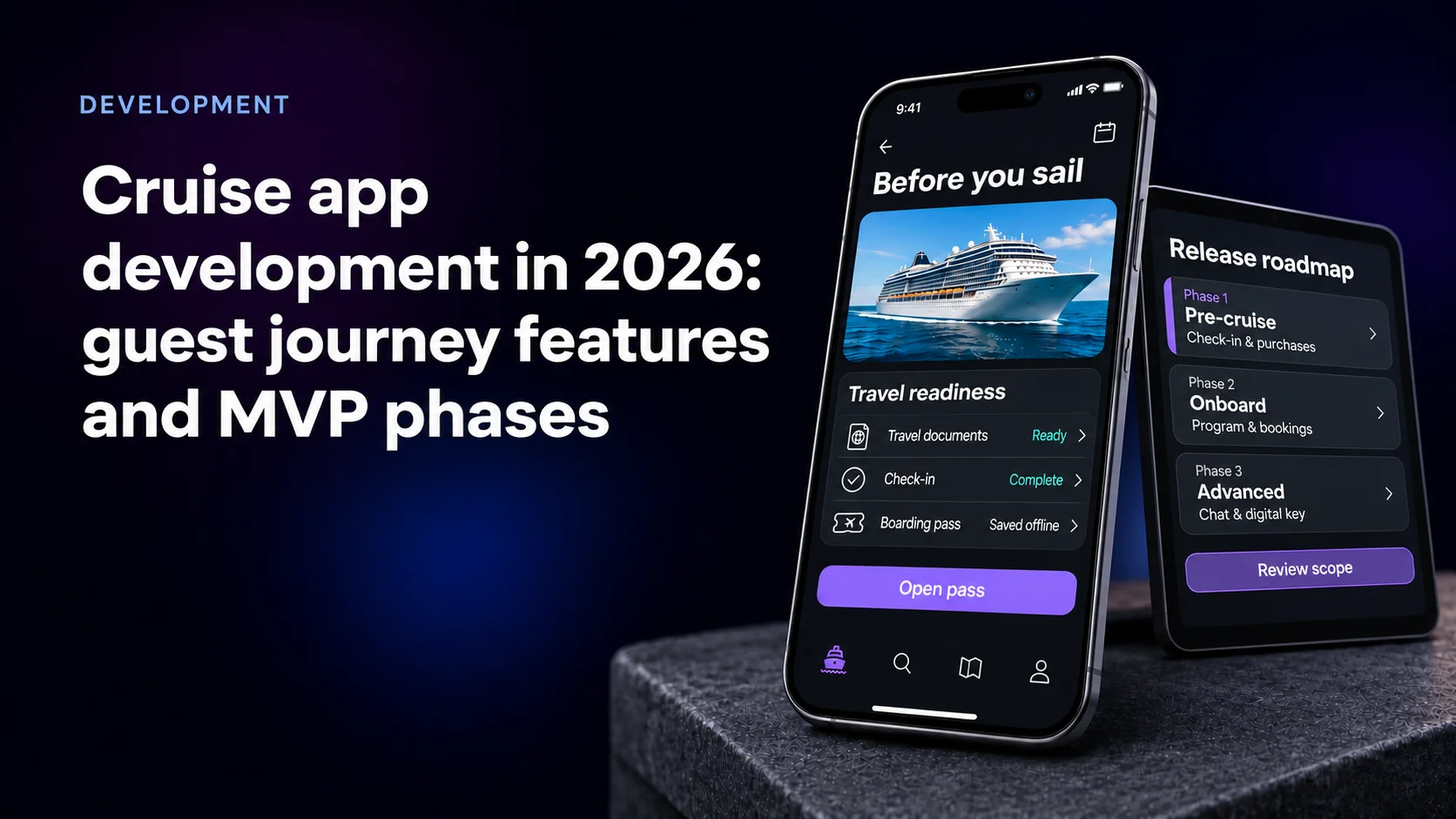
- Release 1 ships ashore: readiness checklist, check-in, an offline boarding pass and pre-cruise purchases on the reservation system.
- Release 2 moves aboard on ship Wi-Fi without internet: daily program, deck map, folio and bookings from ship servers.
- Release 3 adds what needs hardware or peak-load proof: ordering, chat, wayfinding and a digital key. Aroya's October 2026 app deferred exactly those last three.
- Across Mercury Development's closed cruise software contracts, the median is $250,000.
Why the guest app now carries the cruise
Seatrade Cruise News, citing CLIA, counted 37.2 million ocean cruise passengers in 2025, up 7.5% on 2024, with 22.1 million from North America. Most of them meet the line in an app weeks before they see the ship.
The money follows. Royal Caribbean Group's 2025 results release says nearly 50% of onboard revenue was booked pre-cruise and 90% of pre-cruise purchases came through digital channels. On the second-quarter 2025 call, CEO Jason Liberty said nearly 50% of onboard purchases now come through the mobile app, up from a third in 2023.
So the guest app is the check-in desk and the sales counter at once. Each job lives on a different system, and that is the whole difficulty.
Aroya's October launch shows a phased guest app
On October 1, 2026, Cruise Industry News reported that Aroya Cruises had launched native iOS and Android apps in English and Arabic. The first release books voyages, manages reservations, runs digital check-in with pre-cruise and post-cruise checklists, and covers time aboard: the daily program, dining and venue reservations, spa bookings, shore excursions and folio access. Selected onboard features work without paid Wi-Fi.
Three things were left for later: onboard messaging, wayfinding and a digital cabin key. That is a sensible cut. All three depend on ship infrastructure and on behavior you can only prove at sea. Everything in the first release reads from the booking system, the CRM and other operational systems the app is linked to.
Two store dates frame any 2026 release plan. Since April 28, 2026, Apple requires uploads to App Store Connect built with Xcode 26 and an iOS 26 SDK. Since August 31, 2026, Google Play requires new apps and updates to target Android 16, API level 36. In Europe, Directive (EU) 2019/882 covers websites and mobile applications of waterborne passenger transport services provided to consumers after 28 June 2025.
How we put this guide together
We read the pages that answer this question in AI search today. Dev Technosys and Abbacus Technologies write about booking apps for agencies and aggregators. OnDeck Software by Sourcetoad lists onboard features from 2023. None maps features to the network and system each one needs, and none sets release gates.
Line behavior comes from public pages and filings read in November 2026. Patterns from Mercury Development's cruise programs appear without client names or counts. Mercury Development builds this software, so read this as an interested view.
The guest journey at a glance
| Stage | Network the guest has | System that answers | Features | Release |
|---|---|---|---|---|
| Booked, weeks out | Home internet | Reservation system, payment gateway | Account, itinerary, packages, dining, excursions, spa | 1 |
| Check-in window | Home internet | Reservation system, document checks | Travel checklist, passport, photo, arrival slot | 1 |
| Embarkation day | Patchy cellular at the pier | The phone itself | Boarding pass stored offline, terminal directions | 1 |
| Aboard, everyday | Ship Wi-Fi, no internet | Ship servers, onboard property system | Daily program, deck map, folio, bookings | 2 |
| Aboard, at peak | Ship Wi-Fi under load | Ship servers, kitchens, sensors, locks | Ordering, chat, wayfinding, digital key | 3 |
| Port day | Roaming or none | Ship time, itinerary | All-aboard time, offline port guide | 2 |
| Last morning and after | Ship, then home | Folio, reservation system | Final folio, post-cruise checklist, rebooking | 2 |
Pre-cruise: readiness and pre-purchase ship first
Start where the network is reliable and the revenue is early. Royal Caribbean's app help pages list what a mature pre-cruise flow covers: internet and beverage packages, spa services, specialty dining, shore excursions, dining seating times and entertainment, all bought before the guest boards. Check-in opens in the app 45 days ahead and stays open until sailing morning.
The hard part is the readiness record. Each guest owes a different set of steps: personal details, a passport, a photo, a payment card, an arrival slot. The app should show what this guest still owes, read from the reservation system, and stop guessing. Our cruise mobile check-in guide covers passport capture and the travel checklist in detail.
Pre-purchase needs one more decision before code: the payment rail. Drinks and dining are consumed on the ship, as are spa treatments, so they go to a card or the cabin folio, and PCI DSS scope belongs in the release plan. Our guide to onboard revenue in the app walks through package entitlements and dining credits.
Embarkation day: a boarding pass that needs no signal
The pier is the worst network of the trip. Thousands of phones, one terminal, a congested cell. A boarding pass that loads from a server at the gate fails there.
Store it on the device at check-in. Put it in Apple Wallet too, as Royal Caribbean does. Show the arrival slot the guest picked, because Royal Caribbean expects guests to arrive within it. Then test the screen in airplane mode, with the brightness a terminal scanner needs.
Onboard: the ship is the server
Royal Caribbean tells guests they need no internet package to use its app aboard: they join the ship's Guest Wi-Fi and the app works. That sentence describes an architecture. The daily program, the deck map, the folio and reservations come from servers on the ship, and the satellite link is somebody else's problem.
Build release 2 on that rule. Read-heavy screens first: today's program, the deck map, the folio, existing bookings. Then bookings that the ship confirms locally, such as dining tables and activity seats. Push notifications from Apple and Google need the public internet, so a guest on free ship Wi-Fi may never see them; our push notification guide explains local push from a ship server.
Release 3 holds the features that need more than a server. Ordering has to survive a sea-day peak. Chat needs moderation and the ship network for every message; Royal Caribbean offers guest chat at no charge on Guest Wi-Fi and connects cabin mates automatically. Wayfinding needs beacons or another location layer, and a digital key needs the lock vendor. Royal Caribbean also notes its app runs on every ship while some features vary by ship, which is what a phased fleet looks like from the guest side.
Port days and the last morning
On a port day the guest leaves the ship network. Anything they need ashore must already be on the phone: the all-aboard time, the excursion meeting point, a port map. Show all-aboard in ship time, labeled as ship time, because the phone's clock may follow the local network. Our date line guide covers how to publish ship time from the ship server.
Location features stop at the gangway too. Royal Caribbean says Find My Kid works only aboard, on the ship's Wi-Fi, and not in ports. Tell guests that in the app, before they rely on it.
The last morning closes the loop: the final folio, disembarkation timing, then a post-cruise checklist and the next booking at home. Aroya put the post-cruise checklist in its first release.
MVP phases: three releases gated by systems
Each release opens when its systems are ready. The screens wait for them.
- Release 1, ashore. Account and booking link, readiness checklist and check-in, offline boarding pass, pre-cruise purchases. Gate: a reservation API that works in your QA environment, a payment rail with PCI DSS scope agreed, and store accounts on current Apple and Google toolchains.
- Release 2, aboard on ship Wi-Fi. Daily program, deck map, folio, bookings confirmed by the ship, all-aboard time in ship time. Gate: ship-side endpoints, a sign-in that keeps working when the phone moves from shore to ship, and a test window on a real vessel.
- Release 3, aboard at peak. Ordering, chat, wayfinding, digital key. Gate: a load test at sea-day arrival rates, beacon or lock hardware installed on the target ships, and a ship-by-ship rollout plan.
Norwegian Cruise Line ran that last step in public. Its new app was first tested by guests on Norwegian Sky's sailing from Miami on August 30, 2024, and the line said it would roll out ship by ship. Our guide to testing on a real vessel covers how to plan that sailing.
Accessibility runs through all three releases. Build to WCAG 2 level AA from release 1, because a deck map and a dense daily program are hard to retrofit.
What our cruise programs show
For cruise line clients Mercury Development cannot name under NDA, we have rebuilt a passenger app on React Native instead of porting the old one. The scope across those programs covers pre-cruise readiness and a travel checklist, the boarding pass, a ship map and navigation, guest and crew chat, restaurant booking, a trip planner and payment methods. ADA and PCI DSS reviews acted as release conditions. On one program, pre-cruise dining plans went into the MVP while onboard availability waited for a later release.
Delivery patterns from that work: a sign-in token issued ashore stops working on the ship. An API works in production and fails in QA. Test accounts expire, and VPN access is slow to arrive. Some behavior reproduces only on a real ship. Our guide to building when the backend is not ready turns those into a pre-kickoff checklist.
Our onboard spa platform for OneSpaWorld, which describes itself as the operator of health and wellness centers onboard cruise ships, has run since 2018 on over 160 ships operated by multiple cruise lines, on onboard servers without external internet. Its activity booking shows a calendar filtered by event type, books for one guest or several, keeps a waitlist when places run out and builds a personal schedule. We also built a spa pre-booking site for Windstar Cruises guests, replacing bookings through OneSpaWorld's call center.
Our accessibility practice has built WCAG 2 level AA compliant mobile and web apps, including ADA work for passenger transport services. From Mercury Development's contract records: across our closed contracts for cruise software, the median is $250,000 and the range runs from $10,000 to $1,000,000.
Phase a cruise app by its networks
Most cruise app plans are lists of screens. Dev Technosys prices a cruise booking app at $8,000 to $25,000, and for a catalog with checkout that may be fair. A guest app is a different product. It reads a reservation system ashore, a property system aboard and hardware in the corridors, and each of those decides when a feature can ship.
So change the planning question. Skip "which screens go in the MVP". Ask: "Which of these systems answers in QA today, on shore and on the ship?" Whatever answers goes in release 1. Whatever does not gets a gate with an owner and a date.
Then own what you pay for. Mercury Development's About page states that the customer owns the code and all underlying IP.
Written by Rob Devereaux, Chief Operating Officer at Mercury Development. Rob has run the firm's operations from Hudson, Ohio since 2019 and has over 20 years of operational and financial experience. The contract and delivery records behind this article's figures on Mercury Development's cruise programs sit in the operations he oversees.
Planning a cruise guest app? Map the systems behind each release
Tell us which systems hold your bookings and folios, and which of them your app can reach from shore and from the ship. We will map each feature to its system and its release, and mark the gates you need to clear before each one ships.