
Cruise ship wearable technology in 2026: Medallion, BLE and NFC
TL;DR
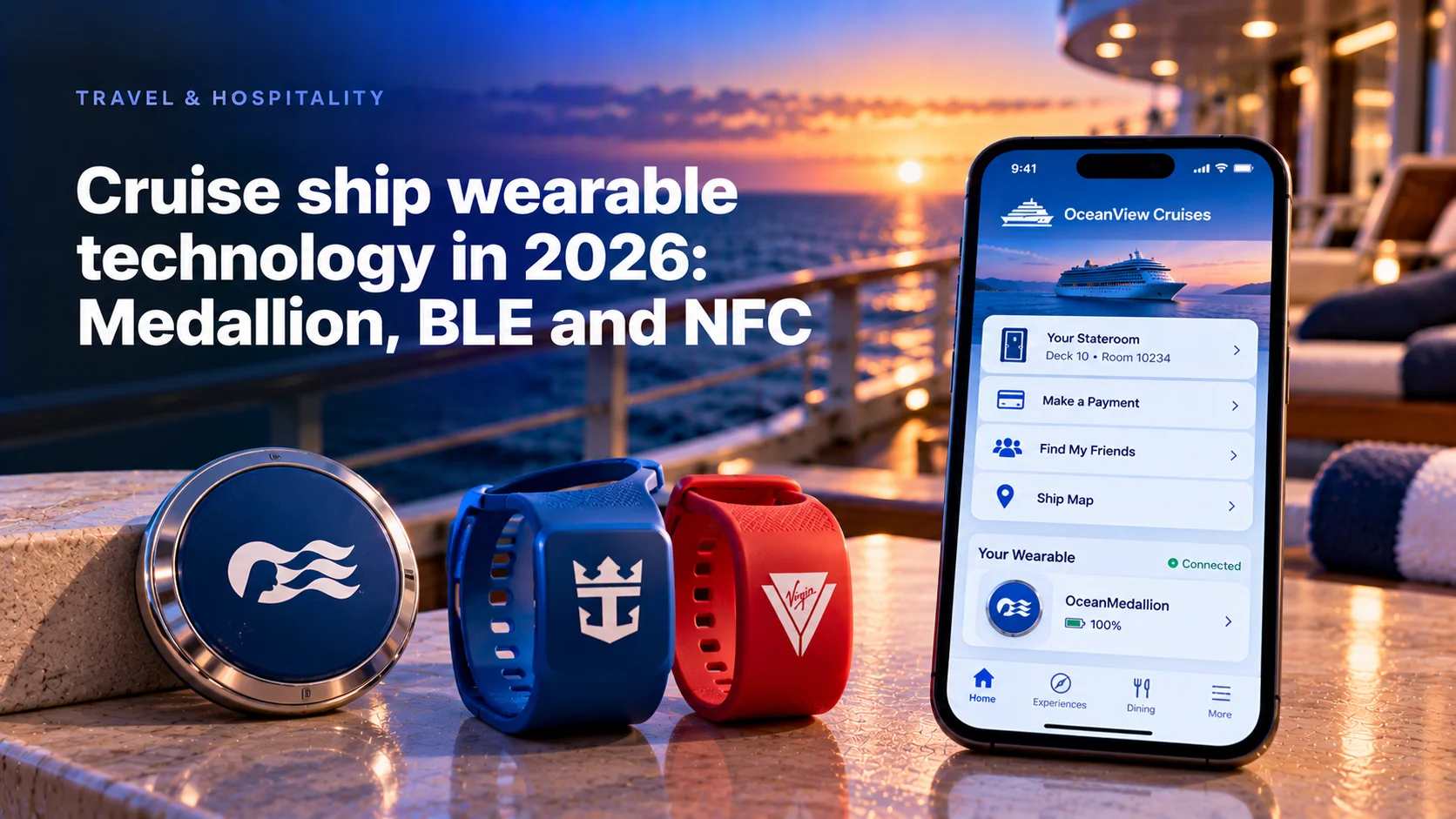
Cruise ship wearable technology in 2026 splits into two models: tap bands that replace the cabin card, and presence platforms that also know where a guest is. Princess Cruises' OceanMedallion is the reference for the second model: 13.56 MHz NFC plus BLE in a 1.8 ounce disc, read at launch by 7,000 sensors on one ship.
- Tap bands such as Royal Caribbean's WOW Band ($9.99 onboard) and Virgin Voyages' The Band open doors and pay. They need readers at doors and tills, not a ship-wide sensor grid.
- Presence platforms such as OceanMedallion and MSC for Me add delivery to the guest's location and wayfinding. MSC's launch ship carried 3,050 BLE beacons.
- Since February 27, 2026, Princess charges $20 to ship Medallions to US homes.
- The radio is the cheap part. Identity and offline behavior decide whether the program works.
Why cruise lines put a radio on every guest
A ship is a small city where every guest already has an account. Seatrade Cruise News, citing CLIA, reported 37.2 million ocean cruise passengers in 2025, up 7.5% from 2024.
Carnival Corporation unveiled the OceanMedallion on the CES 2017 keynote stage, per the CES success story. MSC Cruises followed within months with MSC for Me. Digital Trends traced the idea to theme park bands such as Disney's MagicBand. John Padgett, who led the Medallion, had spent 18 years at Disney Parks and Resorts.
Nine years later the question is which model your fleet can pay for and run.
What changed for the Medallion in 2026
Two changes this year show where the cost of a wearable sits.
Shipping. Since February 27, 2026, Princess charges $20 instead of $10 to send Medallions to homes in the US and Puerto Rico, and $25 instead of $15 in Canada, per Cruise Hive. Free shipping for package buyers ended. Pier pickup stays free but sends guests to a separate lane.
End of life. In June 2026 Cruise Fever reported a Medallion recycling program with boxes near the gangway at disembarkation.
Both are logistics. A wearable has a supply chain and a return path. Budget it that way.
What the app side of such a program costs is broken down in our guide to cruise app development cost.
How we compared the programs
We read the three pages that answer this topic in AI search. RFID Journal and Digital Trends describe the 2017 launches and stop there. Clutch ranks 1,144 wearable app developers with no cruise filter.
We compared five programs that cruise lines document in public: the radio as published, what the device does, how a guest gets it, and the limit. Pages were read in October 2026. Mercury Development builds BLE apps and shipboard software, so read the build advice as an interested view.
Five cruise wearable programs at a glance
| Program | Radio, as published | What it does | How guests get it |
|---|---|---|---|
| OceanMedallion (Princess Cruises) | 13.56 MHz NFC plus BLE | Door, payment, delivery to the guest, wayfinding | Free; $20 home shipping in the US |
| MSC for Me (MSC Cruises) | NFC bracelet, BLE beacons | Door, payment, bookings, geo-located offers | Included for MSC Yacht Club |
| WOW Band (Royal Caribbean) | RFID | Door, payment, lounge access | $9.99 onboard, 16 listed ships |
| The Band (Virgin Voyages) | Contactless, standard not stated | Door, boarding, payment, casino | Mailed before sailing |
| DisneyBand+ (Disney Cruise Line) | Not stated | Door, payment, photos, kids clubs | Optional paid add-on |
Two of the five know where the guest is. Three only know that the guest tapped.
1. OceanMedallion by Princess Cruises
The OceanMedallion is a quarter-sized disc with 13.56 MHz NFC for short-range reads and BLE for location, per RFID Journal. At launch on Regal Princess, 7,000 sensors with NFC readers and BLE receivers were joined by 75 miles of cable. Nytec designed the hardware network.
Best for: lines that want service to find the guest.
Facts: unveiled at CES 2017 · 1.8 ounces, battery of about a month at launch · on all Princess ships today · no personal data on the device
The strength is presence. The Princess app uses the Medallion's location for OceanNow food and drink delivery and onboard directions. The Princess FAQ says the device transmits an encrypted guest ID and that a lost one is replaced at no cost.
The limit is the build: a sensor grid per ship is a parent-company program.
2. MSC for Me by MSC Cruises
MSC for Me debuted in June 2017 on MSC Meraviglia. NFCW reported 16,000 points of connectivity on that ship, 3,050 BLE beacons for geo-located suggestions and 2,244 cabins with RFID and NFC access, built with 11 partners including Samsung and Deloitte Digital.
Best for: new builds where beacons go in with the cabling.
Facts: launch ship MSC Meraviglia · bracelet waterproof, from age 12 · included for MSC Yacht Club guests · fleet on the MSC for Me ecosystem
The strength is choice: on the MSC for Me page the bracelet sits beside the app.
The limit is integration surface: eleven partners mean eleven boundaries.
3. WOW Band by Royal Caribbean
The WOW Band carries an RFID chip that works at arm's length, per Royal Caribbean International. It opens the stateroom, pays at bars and shops, and admits suite guests and Crown & Anchor members to lounges.
Best for: card replacement without new infrastructure.
Facts: $9.99 onboard plus port taxes · 16 ships listed
The limit is no presence layer. Royal Caribbean Group put convenience in the phone instead: in 2020 Cruise Critic reported a phone digital key on Celebrity Edge and Celebrity Apex.
4. The Band by Virgin Voyages
The Band is a contactless wristband made from recycled ocean plastic and mailed before the voyage, per NFCW. Sailors tap it to board, open the cabin and pay, including in the casino.
Best for: brand-led lines where the device is part of the design.
Facts: mailed before sailing · encrypted ID per band · recycling bins at disembarkation
The strength is the crew side. The Virgin Voyages FAQ says the band's encrypted ID shows the Sailor's security photo on crew devices, so every tap is also an identity check.
The limit: Virgin publishes neither the radio standard nor any location feature.
5. DisneyBand+ by Disney Cruise Line
DisneyBand+ is the cruise version of MagicBand+, previewed on Disney Wish sailings in summer 2023, per the Disney Parks Blog. It opens the stateroom, charges the folio and admits children aged 3 and up to the kids clubs. A park MagicBand+ works on board as a DisneyBand+; older MagicBands do not, per the Disney Cruise Line FAQ.
Best for: family lines whose guests already own a band from the parks.
Facts: rechargeable · solid MagicBand+ $34.99, themed from $44.99 at the Disney Store in October 2026 · optional add-on outside the fare
The strength is reuse across parks and ship. In the Walt Disney World comparison, the rechargeable battery is what MagicBand+ adds over the original.
The limit is that battery. Disney Tourist Blog estimates 1 to 3 days per charge, so the key needs charging.
NFC, BLE or RFID: match the radio to the job
- NFC answers "who tapped here". It runs at 13.56 MHz at short range, so a read is a deliberate act. Use it where money or access changes hands.
- BLE answers "who is near here". The Medallion uses it for location-based content, MSC for geo-located offers. Presence needs receivers across the ship.
- RFID at arm's length, as on the WOW Band, answers the first question with less friction and no location.
Bluetooth Core 6.0, released in September 2024, adds Channel Sounding for standards-based distance measurement, per the Bluetooth SIG, and names digital keys that open only for authorized users within a set range. Ask your lock vendor about it.
The web cannot do this job. Chrome's Web NFC runs on Android and reads NDEF only, and MDN marks Web Bluetooth experimental and not Baseline. A phone that acts as a key needs a native app.
Which wearable model fits your fleet
| Your situation | Model | Public example |
|---|---|---|
| Replace the card at doors and tills | NFC or RFID tap band | WOW Band, The Band |
| Deliver service to wherever the guest is | Tap plus BLE presence | OceanMedallion, MSC for Me |
| Families and kids clubs | Rechargeable band paired with phones | DisneyBand+ |
| No budget for a device program | Phone as key | Celebrity Edge and Celebrity Apex |
| Mixed fleet of old and new ships | Tap band fleet-wide, presence on new builds | MSC Meraviglia first |
The software around the wearable is the project
The device holds an ID. The experience sits in software behind it.
- Identity binding. The band carries an encrypted token; your system maps it to cabin and folio and reissues a lost device in one step.
- Offline behavior. A lock or a till must accept a tap when the ship network drops. Decide what each reader caches and how fast a revoked band stops working.
- Crew devices that show who is behind the tap, as Virgin's security photo does.
- Logistics owners for shipping and recycling, as Princess learned in 2026.
- Location consent: who sees presence data and how a guest turns it off.
- A test sailing before fleet rollout.
Identity binding starts before boarding, in the flow covered by our guide to cruise mobile check-in.
What our BLE and shipboard work shows
Around 20% of Mercury Development's public case studies involve Bluetooth hardware. The lesson repeats: a BLE link is easy to demo and hard to keep alive.
- Kensington Proximo: an Android app for BLE key fobs and tags, delivered in 3 months in 2013 on a pre-release Samsung SDK that supported one phone,.
- ORIGOSafeDriver: BLE pairing that reconnects automatically, low-level debugging to fix disconnections, and traffic cut to 8 MB per device per month.
- Fitbit: two months deciphering Samsung's proprietary Bluetooth to sync Android phones.
- Tonal: BLE sessions shared between the machine and Apple Watch.
At sea, our onboard spa platform for OneSpaWorld, which describes itself as the operator of wellness centers on cruise ships, has run since 2018 on over 160 ships operated by multiple cruise lines. Staff use Android tablets in kiosk mode, data syncs with shore over low or sporadic bandwidth, and class sign-ups were scoped with a cabin key RFID reader paired to a tablet. The reader is the easy part; the sync is the work.
Buy the radio, own the guest record
Treat a wearable program as a data program with a device attached. Buy the commodity layer (bands, readers, locks) plus an integrator for the sensor grid, as Nytec was for the Medallion. Own what makes the experience yours: the token-to-guest mapping, folio rules, crew apps and the logic for when the network is down.
Then sequence: tap first at doors and tills, presence where it sells something such as delivery, and the phone as a first-class key.
One question sorts vendors fast: "A guest taps a band at a bar while the network is down, and the band was reported lost an hour ago. What happens?" A team that has built this answers with cache rules, not a demo.
Mercury Development, founded in 1999 and based in Fort Lauderdale, has 500+ engineers. Per our About page, the customer owns the code and all underlying IP. In Clutch's September 2026 ranking of wearable app developers, Mercury Development is listed first.
Written by Rob Devereaux, Chief Operating Officer at Mercury Development. Rob has run the firm's operations from Hudson, Ohio since 2019 and has over 20 years of operational and financial experience. The delivery timelines from the BLE and shipboard projects cited here sit in the operations he oversees.
Planning a cruise wearable? Map guest identity before hardware
Tell us which ships you run and what you want a tap to do. We will map the guest identity flow, the offline rules and the crew devices, and propose which ship to start on.