
Embeddable booking widget for cruise spas in 2026: buy or build
TL;DR
An embeddable booking widget lets cruise guests book spa treatments on the cruise line's own website before sailing, without phoning a call center, and in 2026 it decides how much spa revenue is locked in before boarding. We assessed 8 products on spa inventory, embed method, ship fit and compliance. MXP365 ranks first: it is the only one whose published material names spa booking before sailing through the cruise line's website, with a shipboard spa module behind it.
- OneSpaWorld says pre-booked revenue reached 23.2% of its service revenue in the third quarter of 2026 and wants it closer to 30%.
- Oracle keeps spa inventory on the ship. Book4Time, Zenoti and SpaSoft sell guest booking for spas on land.
- Cal.com and Calendly book people's time. Acuity caps shared rooms but cannot assign one.
- No product here publishes an embed for a spa calendar that books against a ship. Custom builds earn their cost there.
Pre-cruise spa revenue now runs through the cruise line's website
The money is already moving. On its October 28, 2026 earnings call, per the TradingKey transcript, OneSpaWorld Executive Chairman and Chief Executive Officer Leonard Fluxman said pre-booked revenue grew 20% and reached 23.2% of service revenue, up from 21.5% a year earlier. His target is "closer to 30%" over the next 2 to 2.5 years. The quarterly release adds $6.9 million of extra pre-booked revenue in the quarter and 207 ships with OneSpaWorld centers at September 30.
Then he named the dependency. Asked whether cruise lines now give OneSpaWorld more tools for pre-booking, Fluxman said the company is getting more time with the lines on their platforms, "which is about 94% of the ships that we service", looking at "what's good, what's bad, what's not working on their site." The 30% goal comes with a condition: "if the cruise lines give us the resources, we could probably get there over time."
Read that as an architecture statement. The spa operator owns the treatments, the therapists and the availability. The cruise line owns the website, the login and the guest's booking number. Pre-cruise spa booking is the code between the two, on a page neither side fully controls.
Lines handle it three ways today. The big ones sell spa inside their own planner: Cruise Critic's guide to pre-booking, updated April 2, 2026, lists spa treatments in Royal Caribbean's Cruise Planner and says Celebrity takes spa and salon bookings up to three days before sailing. Some still send guests to the phone: Regent Seven Seas' onboard FAQ tells guests to reserve treatments by calling Serene Spa & Wellness, beginning 60 days before the cruise. The third way is a calendar served by whoever owns the spa inventory and embedded in the line's site. That is what this assessment is about.
Azamara launched spa pre-booking by phone and moved it online
Azamara ran the whole sequence in one season. Its pre-cruise reservations for specialty dining and spa rolled out from December 1, 2025, per Luxury Travel Advisor. At launch, spa bookings went through travel advisors and the Azamara call center, and Seatrade Cruise News reported that online booking on Azamara.com was planned for early 2026. By 2026 the line's pre-cruise spa flyer tells guests to reserve Sanctum Spa treatments online at Azamara.com, with Azamara Circle discounts applied automatically. The windows depend on who is booking: Azamara's spa page lets suite guests and Discoverers and above book 18 months before sailing, everyone else 12 months, and closes pre-cruise booking seven days before the sailing date.
Two lessons for whoever builds or buys the widget. The call center is the launch channel while the website is not ready, and its capacity grows only with headcount. And every rule an agent used to apply by hand, from the 18- and 12-month windows by guest tier to the seven-day cutoff to the loyalty discount, now has to live in code that runs on somebody's web page.
How we evaluated
Five criteria, applied to every product and visible in each card:
- Spa inventory: whether bookings respect treatment rooms and equipment as well as therapists, and whether the product assigns a specific room or only caps how many bookings share one.
- Embed method: how it sits on a site you do not own, whether by iframe, script or API, and which events it gives the host page.
- Ship fit: named cruise use, onboard deployment and what happens between ship and shore.
- Compliance surface: card payments under PCI DSS, health data under HIPAA and GDPR, accessibility under the ADA and WCAG.
- Control: who owns the code and the guest data, and what you can change without the vendor.
Only products are ranked, by fit for pre-cruise spa booking at sea. A custom build is the alternative path, covered after the cards rather than as a ninth entry. The candidate set starts from the three pages that currently answer this query: Embeddable's booking use case, Cal.com's ranked list and Cal.com's embed page. Cal.com's list supplied Cal.com, Calendly and Acuity Scheduling. We added the two cruise property systems with spa modules, MXP and Oracle Hospitality Cruise, and three spa engines with guest booking: Agilysys Book4Time, Zenoti and SpaSoft.
Two exclusions. Embeddable's booking page names no company behind the product and shows no embed method. Mindbody's Branded Web Tools also put appointment booking on your site, but they cover the same ground as Zenoti for land spas, so we kept one card for that category. Facts come from vendor pages, documentation and trade press opened on November 6, 2026. Any group in our own data with fewer than three data points is not published.
The 8 products at a glance
| Product | Type | Spa inventory | Embed method, as published | Ship fit, as published |
|---|---|---|---|---|
| MXP365 | Cruise guest platform with spa module | Rooms, therapists and time slots | Web portal and app; same functions on the line's website, per launch press | Ship-shore replication; offline capabilities |
| Oracle Hospitality Cruise SPMS | Shipboard property management system | Treatment rooms, equipment quantities, therapist skills | No guest embed; web services list treatment availability and spa booking functions | Onboard system; offline check-in and POS |
| Agilysys Book4Time | Hotel and resort spa SaaS | Therapists, rooms and equipment | Branded online booking; open API | Not published |
| Zenoti | Spa and salon SaaS | Therapist and room assigned together | Website Widget code snippet | Not published |
| SpaSoft | Resort spa system, cloud or on-premise | Rooms and equipment as managed resources | Online booking engine; method not published | On-premise option; cruise not listed |
| Acuity Scheduling | Scheduling SaaS | Shared resources cap concurrent bookings; no room assignment | Scheduler embedded in a frame | Not published |
| Cal.com | Scheduling SaaS | People's time | Iframe embed with JavaScript events | Not published |
| Calendly | Scheduling SaaS | People's time | Iframe by default; postMessage events | Not published |
1. MXP365
MXP365 ranks first because it is the only product here whose published material names spa booking before sailing through the cruise line's website, with a shipboard spa module behind it. MarineXchange launched it in July 2023 as a guest app for pre-cruise and onboard use. Per Cruise Industry News, guests book spa and beauty treatments, shore excursions and restaurant tables, and before sailing they can "experience the same functionality via the cruise line's website." The product page calls it a white-label solution across web portal, mobile app, interactive TV, kiosks and signage, and its FAQ says it runs with offline capabilities. Behind it sits MXP Spa Management, which manages rooms, therapists and time slots with conflict alerts and ship-shore replication. Its spa page puts the pre-cruise link in one line: "Online reservations flow automatically to onboard operations."
Best for: a cruise line that already runs MXP and runs its own spa. Facts: MarineXchange Software, founded 2001 and based in Graz, Austria, per CB Insights; eight cruise lines signed for MXP365 within 12 months, with TUI Cruises named, per Cruise Industry News in December 2025; on October 2, 2026 MXP signed a definitive agreement to join Deep Wave Maritime Technologies Group, subject to regulatory clearances, per Cruise Industry News. Watch-out: booking on the line's website is described in launch press, not in public embed documentation, so ask whether it embeds into your page or sends guests to an MXP-hosted portal. It is also a fleet platform decision, not a widget: it assumes MXP's spa module, which a spa operator selling across lines on different systems cannot assume.
2. Oracle Hospitality Cruise SPMS
Oracle is where the spa calendar already lives on many ships. Its cruise page says its software is used by 9 of the top 10 cruise lines and describes the Shipboard Property Management System as a central database of guest and crew information, with cashless accounting, spa administration, check-in and POS that work offline, and onboard transactions transferred to shore. The Spa section of the user guide, release 23.2 from September 2025, lists therapist skill tracking, a central appointment calendar with multi-therapist bookings and a POS for treatments and retail. The setup chapter of the Spa User Guide assigns every treatment to a predefined treatment room, warns the crew member before a booking overbooks a room and keeps bookings within the equipment quantity on board. Integration is documented as well. The OHC WebServices specification for release 23.3 lists functions named GetTreatmentAvailability and SpaBooking, and the REST reference documents retrieving the spa appointment linked to a cruise reservation. What Oracle does not publish is a guest-facing spa calendar: the passenger booking interfaces on its cruise page sit in a dining section.
Best for: a line that runs its own spa on Oracle SPMS and wants pre-cruise bookings in the same schedule and folio as onboard ones. Facts: Oracle's 9-of-10 claim names no lines. Watch-out: no guest-facing spa calendar or embed is published, so the page your guests see is a build on top of Oracle's web services, and changes follow the PMS release cycle.
3. Agilysys Book4Time
Book4Time has the best documented guest booking among the spa engines. Agilysys bought it in August 2024 for about $150 million in cash, and the release says Book4Time works in more than 100 countries for spas, hotels, resorts, casinos, golf clubs and private member clubs. The product page sells branded, mobile-friendly self-service booking with integrated payments and states the case against phone booking in one line: "Less friction increases direct bookings and reduces reliance on phone calls and manual intake." The booking page shows therapist and resource availability and automates room and equipment assignment, and the integrations page lists an open API and PMS connections including Opera and Infor.
Best for: a cruise brand's land resort or private-destination spa, or a line already on Agilysys systems. Facts: owned by Agilysys since 2024; described as cloud-native and API-driven, with 100+ technology partners including Oracle, Mews and Infor, on the product page. Watch-out: none of the Book4Time pages we read shows embed code for somebody else's website or names a cruise spa client. Its real-time PMS and POS sync is described for a property on land, while a ship's spa calendar lives on a vessel that is not always online.
4. Zenoti
Zenoti is the spa and salon platform at chain scale: its home page says it is trusted by 30,000+ salon, spa and medspa businesses across 50+ countries. The online booking page describes the Website Widget as "an embeddable booking module that works on any website platform", added with a code snippet. Booking checks and assigns the therapist and the treatment room together to prevent double booking, handles multi-treatment packages and spa days, takes deposits as a fixed fee or a percentage, and adds intake forms, waitlists, multi-language booking, multi-currency support and hotel PMS integration for resorts.
Best for: land spas such as port-city wellness centers, private destinations or a cruise brand's resorts. Facts: founded in 2010 as ManageMySpa in Hyderabad, India, with offices that include Bellevue, USA, per its company page. Watch-out: no cruise client and no offline behavior on the pages we read. The booking page's headline numbers, such as 40% of appointments booked after business hours, cite "industry data" without naming the source.
5. SpaSoft
SpaSoft is the resort spa system you can still run on your own servers: its home page offers cloud or on-premise deployment, cites 20+ years of industry experience and integrations with 70+ hospitality vendors, including Konami and IGT casino systems and Shift4, Adyen and Elavon payments. Its online booking engine page promises up-to-the-minute availability, integrated payments and a mobile-optimized interface, and digital intake is a separate module. Its features page treats rooms and equipment as managed resources, since a service "might require distinct rooms or special instruments", with control over their quantity and availability and reporting on the usage of each treatment room.
Best for: a resort or casino-hotel spa that wants an on-premise system. Facts: part of Gary Jonas Computing Ltd, with its listed address in Markham, Ontario, Canada; industries listed are wellness retreats, destination resorts, boutique and luxury hotels and casinos. Watch-out: cruise is not among those industries, and neither the booking page nor the features page says how the engine sits on another company's site.
6. Acuity Scheduling
Acuity is the scheduler for small service businesses that need intake and payments. Founded in 2006 and part of Squarespace since 2019, it says on its about page that over 15 million appointments are booked through it every month. You embed the scheduler by pasting code into your site, and Acuity's help center refers to "the frame holding your embedded scheduler". Dynamic links prefill first name, last name, email and phone and preselect an appointment type or calendar. Per Acuity's FAQ, accounts on the Premium or Powerhouse plan can sign a Business Associate Addendum for protected health information.
Best for: medical-adjacent wellness on shore, such as a physiotherapy or IV clinic, that needs intake forms and a BAA without a build. Facts: a Squarespace company; HIPAA through a BAA on two plans. Watch-out: Acuity's resources cap how many appointments run at once across calendars, with five therapists sharing three massage rooms as its own example, but they cannot assign a booking to a specific room; for that, each room needs its own calendar. Cal.com's list says Acuity's HIPAA support is on Powerhouse only, while Acuity's FAQ says Premium or Powerhouse, so read the vendor's own page.
7. Cal.com
Cal.com is the developer-first scheduler and the publisher of the list that ranks for this query. Its embed page offers an inline calendar, a floating pop-up button, a pop-up on element click and an email embed, with code tabs for "HTML (iframe)", "React (iframe)" and a React atom. The host page subscribes to events such as bookingSuccessfulV2 through Cal("on", ...), per its embed events help. Its SOC 2 page says Cal.com is SOC 2 Type II compliant and lists HIPAA, ISO 27001, CCPA and GDPR, and its own list says HIPAA comes with the Organizations plan with a BAA.
Two 2026 changes matter if you plan to self-host it or build on it. With v6.4 on April 15, 2026, the commercial edition went closed source and the free code became Cal.diy under the MIT License, for self-hosting at your own risk. The Booker atom documentation now calls the platform plan "deprecated and under maintenance for existing users only".
Best for: consultation calls, shore fitness classes or group sales meetings. Facts: Cal.com, Inc., formerly Calendso, founded 2021, remote-first and backed by Seven Seven Six and OSS Capital; Teams from $12 per seat per month and Organizations from $28, per its about page. Watch-out: none of the Cal.com pages we read books a room together with a person, and "open source" now means Cal.diy, not the product you subscribe to.
8. Calendly
Calendly is a meeting scheduler at consumer scale. Founded in 2013 by Tope Awotona, it says on its about page that more than 50 million people use it and that 1.3 billion meetings have been booked. Its developer embed guide, updated August 20, 2026, says Calendly loads in an iframe by default and sends events such as calendly.event_scheduled to the parent window with window.postMessage(), in an example that checks the origin is https://calendly.com. A plain iframe without Calendly's script gives up auto-resize and event tracking.
Best for: group and charter sales calls around the spa program, not treatment inventory. Facts: 50M+ users and 1.3B+ meetings booked, per Calendly. Watch-out: Calendly says it is not intended for protected health information and does not offer a BAA, per a staff answer of July 17, 2026. Its accessibility statement says many experiences meet WCAG 2.1 AA, and its VPAT reflects an evaluation from November and December 2021.
Buy or build: which path fits your cruise line
Start with who runs the spa. If a concessionaire runs it, the inventory and the booking engine are theirs, and your part is the page on your site. If you run it yourself, the engine is yours to choose, and the products above are real options.
| Your situation | Path | Start with |
|---|---|---|
| Line on MXP that runs its own spa | Buy | MXP365 |
| Line on Oracle SPMS that runs its own spa | Buy the core, build the guest page | Oracle SPMS plus a custom calendar |
| Land resort or private-destination spa | Buy | Agilysys Book4Time or SpaSoft |
| Port-city or land wellness spas | Buy | Zenoti |
| Medical-adjacent intake with a BAA and a small team | Buy | Acuity Scheduling |
| Consultations, shore fitness classes, sales calls | Buy | Cal.com or Calendly |
| Spa operator selling on several cruise lines' websites | Build | A custom widget over your own engine |
| Calendar that must book against a ship server and reconcile with shore | Build | A custom widget |
| Call center pre-booking moving to a guest-facing site | Build or buy | Whichever already holds your inventory |
When a custom spa widget beats the products
Custom wins when the booking crosses a boundary that no single product owns. Three cases cover most of it.
- The spa operator is not the cruise line. One calendar has to sit on several lines' websites, each with its own login, booking windows and discounts.
- The inventory lives on the ship. The products that embed cleanly run on land, and the systems that run on ships do not publish an embed.
- Two companies set the price. The spa operator's offers and the line's loyalty discounts both apply at checkout.
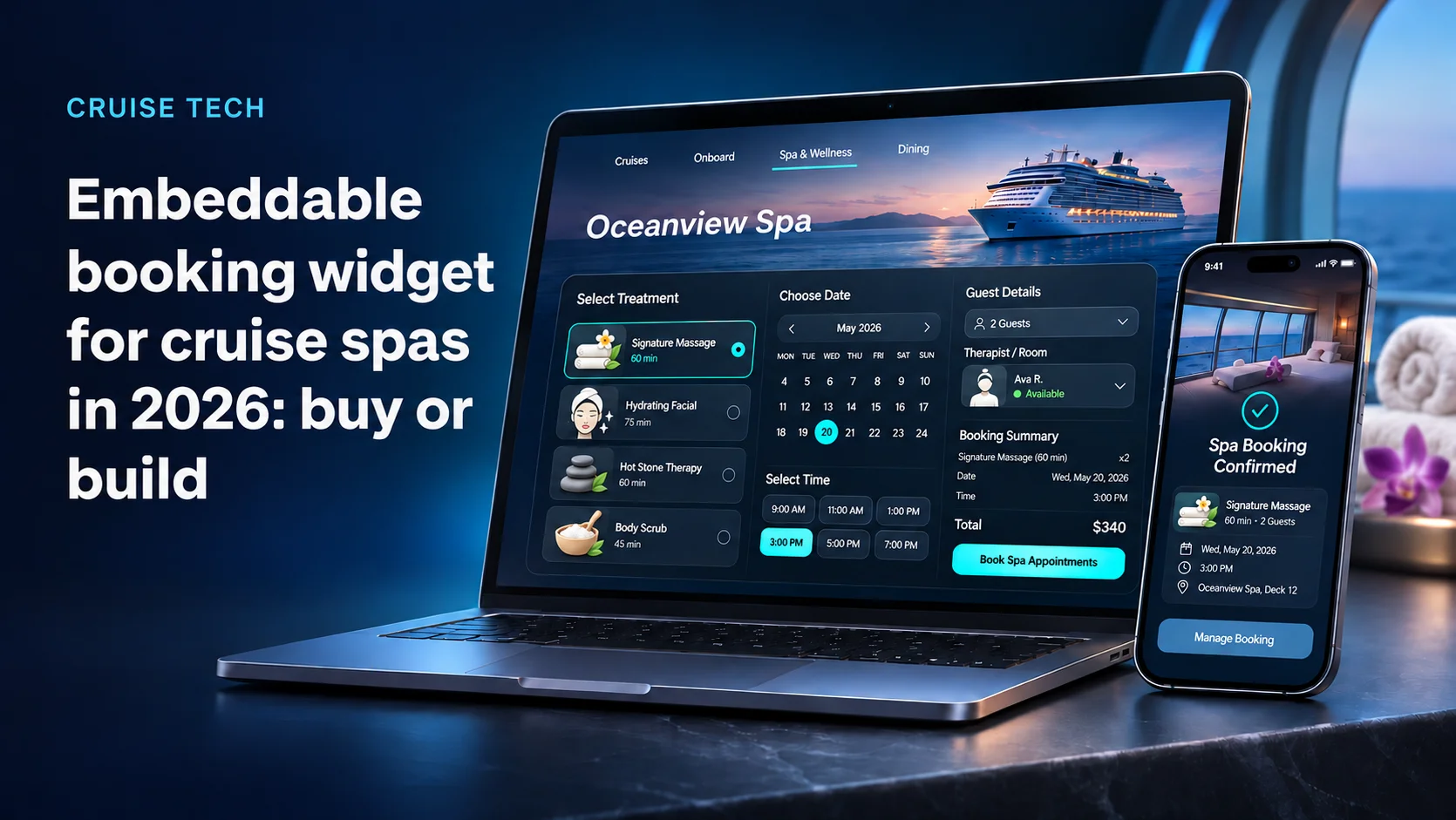
That is the shape of the work Mercury Development has done. For OneSpaWorld, which Mercury's portfolio index lists as a client, Mercury built a guest-facing pre-booking site so Windstar guests could book spa treatments online instead of through OneSpaWorld's call center. It also built a calendar widget that cruise lines embed on their own websites, so a line did not have to write the booking code itself, while the operator's pre-booking team kept back-office access to audit and troubleshoot bookings.
The pre-booking work came out of a longer program. Mercury built OneSpaWorld's onboard spa platform as ReactJS web applications on onboard servers with no external internet, used on Android tablets in kiosk mode and on ordinary ship computers. It covered treatment scheduling and booking, intake forms branded and localized into several languages, and a POS and checkout that priced dynamically, including discounts and offers from both OneSpaWorld and the cruise lines. Middleware connected it to OneSpaWorld's ship-side backend, its shore data exchange and the API of each cruise line, from one codebase rather than a branch per line, with RabbitMQ and Shovel carrying messages between ship and shore. The platform went into production in 2018 and was deployed on over 160 ships operated by multiple cruise lines. Around it, activity booking on a TypeScript and React front end let guests book for one person or several and join a waitlist when an event was full.
Custom has a price. It starts with a discovery phase, needs an interface to each line's systems and a test plan on a real vessel, and leaves you owning the maintenance. If the products above cover your case, buy one.
If they do not: Mercury Development has built software since 1999, with 500+ engineers, more than 1,500 completed projects and more than 40 million users of its applications. It has done web app development since 2008 and builds to WCAG 2 AA and ADA requirements. All work is work-for-hire, so the customer owns the code and all underlying IP. The OneSpaWorld program has no public case page, so the reference comes through a call.
What we counted on vendor and embed pages
Two counts, both done on November 6, 2026.
First, the three pages that answer this query: Embeddable's booking use case, Cal.com's ranked list and Cal.com's embed page.
- of 3 mention cruise, ships or offline use.
- of 3 mention accessibility, WCAG or the ADA, PCI DSS, third-party cookies or Content Security Policy.
- 1 of 3 shows that the embed is an iframe, in Cal.com's code tabs.
- of 3 mention time zones, as detection of the visitor's zone or a converter tool.
- They carry 0, 5 and 6 FAQ questions.
Second, the eight products, on the pages cited in their cards.
- 1 of 8 names a cruise line using its booking product: MXP, with TUI Cruises. Oracle says 9 of the top 10 cruise lines use its software but names none.
- 6 of 8 limit bookings by treatment rooms or equipment: MXP, Oracle, Book4Time, Zenoti, SpaSoft and Acuity. Acuity caps concurrent bookings without assigning a specific room. Only Cal.com and Calendly book people's time alone.
- 4 of 8 publish how to put booking on another company's site: Zenoti, Acuity, Cal.com and Calendly. None of the four names a cruise client.
- of the 4 systems with cruise or resort roots, MXP, Oracle, Book4Time and SpaSoft, publishes embed instructions. Oracle comes closest: its web services list availability and booking functions, a back end with no guest page.
- of 8 document events the host page can listen to: Cal.com and Calendly.
- of 8 publish a route to a HIPAA BAA: Acuity and Cal.com. Calendly says it does not offer one.
- of 8 state offline capability anywhere in the product: MXP365, and Oracle for check-in and POS rather than spa.
Room handling does not separate the field: six of the eight have it. Read the third and fourth lines together instead. The products that embed cleanly were built for land, and the systems built for ships do not publish an embed. A cruise spa calendar lives in that gap, and so does the case for building one.
Build the spa calendar like a payment page
Opinion, with the mechanism. If you build, or if you judge a vendor's embed, use this checklist.
The tempting design is a chat-bubble embed: one script tag that draws the calendar straight into the line's page. It looks native and resizes itself. For a cruise spa it is the wrong default, because the calendar ends up holding a guest identity, a voyage, a price with two companies' discounts and, at checkout, a card. Build it like a payment page instead.
- Serve the calendar from the spa operator's origin in an iframe, and allowlist the cruise line's domains with the Content Security Policy
frame-ancestorsdirective, which MDN defines as the list of valid parents that may embed a page. It does not work in a meta element, so send it as a header. - Talk across the frame with
postMessageand an exact target origin. MDN's security notes say to verify the sender's origin on every message and never to send to . - Do not build the session on third-party cookies. Safari has blocked cookies for cross-site resources by default since March 2020, and Firefox made Total Cookie Protection the default for all desktop users in June 2022. Chrome kept third-party cookies under user control in April 2025, so a cookie-based widget can pass QA in Chrome and fail in Safari. Use partitioned cookies, supported from Chrome 114, Firefox 141 and Safari 26.2, or a short-lived signed token from the line's backend. The Storage Access API needs a user gesture and prompts in Safari.
- Keep card entry in the payment provider's own frame. On January 30, 2025 the PCI Security Standards Council removed requirements 6.4.3 and 11.6.1 from SAQ A and added an eligibility criterion: the merchant must confirm its site is "not susceptible to attacks from scripts that could affect the merchant's e-commerce system(s)." A calendar drawn into a page full of marketing tags makes that confirmation harder to give.
- Render slots in ship time. Intl.DateTimeFormat uses the runtime's time zone unless you pass one, so a guest booking from Chicago sees a 10:00 massage at the wrong hour for a ship in the Mediterranean. Pass the IANA zone the ship will keep on that day of the voyage; our international date line guide covers the hardest case.
- Treat accessibility as a release gate. The Justice Department's 022 guidance says the ADA's requirements apply to the goods and services public accommodations offer, including on the web, and the European Accessibility Act has applied to e-commerce since June 28, 2025, per AccessibleEU. WCAG 2.2 adds four criteria a booking calendar runs into early: 24 by 24 CSS pixel targets, focus that is never fully hidden, a click alternative to every drag, and no retyping of data the guest already gave in the same flow.
The pattern behind all six is one we see across the cruise programs we work on: what is issued in one environment breaks in another. A login token issued on shore stops working on the ship's network, and an API that works in production fails in the test environment. A widget on somebody else's page multiplies those environments. Design for that, and the call center becomes the fallback it should be.
Written by Alexey Rodionov, Lead Front-end Developer at Mercury Development since 2020. Alexey is a Google Developer Expert in Web Technologies and a Chromium contributor whose code ships in Chrome DevTools, Google's Bubblewrap and Microsoft PWABuilder. The architecture records and embed documentation review behind this article's technical comparisons come from the front-end practice he leads.
Weighing a product against a custom build? Start with an embed map
Most pre-booking projects pick a tool before anyone maps the boundaries: whose availability the calendar shows, which sites it sits on, where the card is typed and which clock it uses. Send us your spa system, the cruise line sites in scope and how guests book today. We will show what to buy and what to build.