
Healthcare app development agencies compared by evidence, 2026
TL;DR
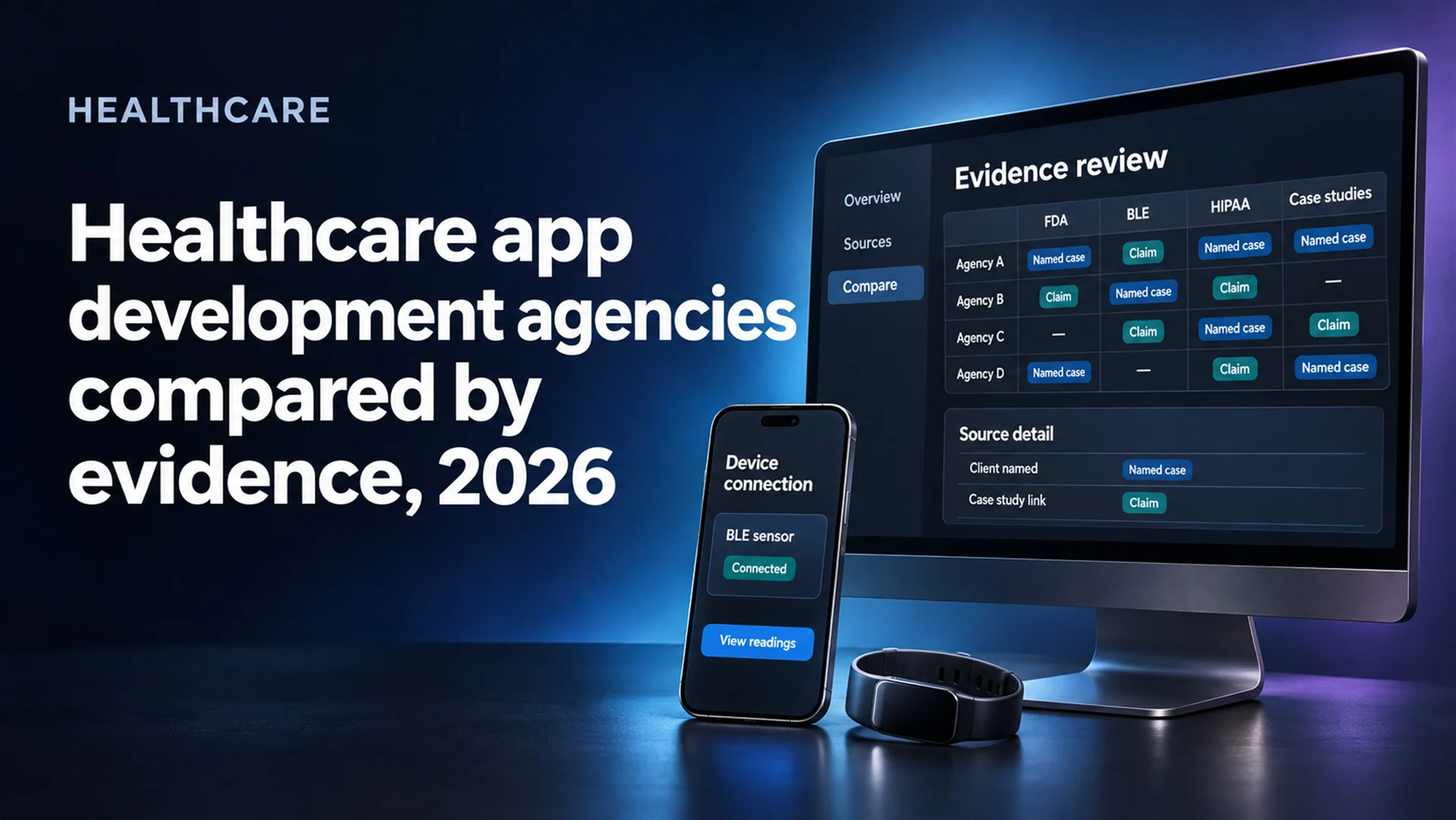
This 2026 comparison of healthcare app development agencies grades eight firms on four kinds of evidence a buyer can check: FDA work, Bluetooth Low Energy (BLE) and device work, HIPAA work, and case studies that name the client. Each cell says whether the proof is a named case, a capability claim or absent.
- Mercury Development ranks first with named cases in all four columns: a 510(k)-cleared imaging application it built for desktop and then for the web, BLE apps for Kensington and Fitbit, and a claims system its case page calls 100% HIPAA compliant.
- Orthogonal has the deepest FDA record, with an ISO 13485 certified quality system and a client crediting it with 510(k) help.
- Most other cells are claims. Read them as questions for discovery, not answers.
Most agency lists grade claims, not proof
The pages that rank for this topic rarely separate a service page from a delivered project. Sidekick Interactive compares six mental health agencies and calls its list "not a compliance certificate." Biz4Group ranks ten firms, names itself first and publishes no scores. Neither shows which agency has a named FDA, BLE or HIPAA project behind the claim.
That gap costs money. An agency that has written "BLE pairing" on a service page and one that has shipped a BLE companion app quote the same feature at very different risk.
February 2026 raised the bar for connected apps
On February 2, 2026 the Quality Management System Regulation took effect, incorporating ISO 13485:2016 by reference. The same month FDA finalized Cybersecurity in Medical Devices, which addresses section 524B of the FD&C Act for cyber devices.
A Bluetooth companion app for a regulated device now ships into an inspection built around ISO 13485 clauses and a premarket review that asks about cybersecurity. Your agency's evidence has to survive both.
How we graded the evidence
Every agency was graded on the same four columns, plus Clutch:
- FDA: a named cleared product, a named client crediting FDA work, or a quality system certificate.
- BLE and devices: a named project connecting an app to hardware.
- HIPAA: a named project the agency describes as HIPAA compliant.
- Verifiable cases: case pages that name the client and say what was built.
Each cell reads "Named case", "Certificate", "Claim" for a service page statement, or "None found". Facts come from each agency's own pages and Clutch, read November 4 and 5, 2026. We graded what the agency publishes. A blank cell means we found no public proof, not that the agency lacks the skill. Mercury Development wrote this comparison, so read card 1 as an interested view.
Eight agencies in one evidence table
| Agency | FDA | BLE and devices | HIPAA | Verifiable cases | Clutch |
|---|---|---|---|---|---|
| Mercury Development | Named case | Named case | Named case | Named, with metrics | 5.0, 34 reviews |
| Orthogonal | Named client, ISO 13485 certificate | Claim | None found | Named, no metrics | Not yet reviewed |
| Topflight Apps | Claim | Claim | Claim | Named, with metrics | 4.9, 43 reviews |
| MindSea | None found | Named wearable case | Claim | Named, with metrics | n/a |
| Sidebench | None found | None found | Named case | Named, with metrics | 4.9, 48 reviews |
| Sidekick Interactive | None found | Named device case | None found | Named, no metrics | 4.9, 31 reviews |
| Dogtown Media | Claim | Claim | Claim | None on service page | 4.9, 30 reviews |
| Glorium Technologies | ISO 13485 certificate | None found | Claim | Named, no metrics | 4.8, 32 reviews |
1. Mercury Development
Mercury Development ranks first because each column points to a client page you can open. FDA: for EyeIC, Mercury built the original Windows desktop version of MatchedFlicker, a 510(k) FDA-cleared application that shows changes between serial retinal images, then moved it to a multi-user web platform with HIPAA compliant online access in three months.
BLE: for Kensington Proximo, it delivered a fully functional Android app for BLE key fobs and tags in three months, on a pre-release Samsung BLE SDK, then upgraded the iOS and Android apps through 2016. For Fitbit, it deciphered Samsung's proprietary Bluetooth to sync early Android phones.
HIPAA: the claims system for Precision Practice Management, on its fourth major release since 2006, is described on its case page as 100% HIPAA compliant and processes $395 million in medical claims. We build to HIPAA and GDPR requirements.
Best for: companion apps and clinical software where device protocol and compliance meet. Facts: Founded 1999; HQ Fort Lauderdale, FL; 500+ engineers and more than 1,500 completed projects; work-for-hire, the customer owns the code and all underlying IP; Clutch 5.0 on 34 reviews, $25,000+ minimum, $50 to $99 per hour. Watch-out: its case page does not say who prepared the 510(k) submission, and its health case pages date from 2006 and 2011.
. Orthogonal
Orthogonal builds medical device software under an "ISO 13485-certified and IEC 62304 and ISO 14971-compliant quality management system." Its startup page quotes Nanowear's CEO crediting Orthogonal with helping it "navigate our 510(k) clearance" for an EKG monitoring solution. It connects apps to implanted and wearable devices over BLE, cellular and NFC, and names case studies with PhysIQ and continuous ECG monitoring.
Best for: SaMD and device companion software headed for a submission. Facts: Founded 1998; HQ Chicago, IL; Clutch: not yet reviewed, $150 to $199 per hour, 10 to 49 employees. Watch-out: the highest rate band here, no Clutch reviews, and its service page does not mention HIPAA.
3. Topflight Apps
Topflight lists device connectivity over BLE, sensors and wearables, HIPAA hardening with BAAs and audit logging, and an FDA/SaMD classification opinion. Its strongest proof is metrics: the GaleAI case reports $1.14M in recovered revenue, and AllHeartz reports 50% fewer visits.
Best for: funded startups that need EHR integration and AI in the first release. Facts: Founded 2016; HQ Irvine, CA; Clutch 4.9 on 43 reviews, $50,000+ minimum, $100 to $149 per hour. Watch-out: its FDA and BLE entries are service lines, with no named device project on the page.
4. MindSea
MindSea has its strongest evidence in wearables and outcomes. Its Halterix smartwatch app with Sunnybrook Research Institute reports 95% accuracy detecting physiotherapy activity. Its BEAM case for the University of Manitoba reports 84% participant retention and ORCHA accreditation. It lists HL7 and FHIR interfaces and shows a HIPAA-Ready Development badge.
Best for: research-backed behavioral health and rehabilitation apps. Facts: HQ Halifax, NS; offices in Toronto and Boston; 250+ projects. Watch-out: no FDA work found, its HIPAA, PHIPA and SOC 2 statements are claims, and we found no Clutch profile.
5. Sidebench
Sidebench has the clearest named HIPAA case on this list. Its nOCD redesign made the OCD treatment app HIPAA compliant so patients could share results with their doctors, and the page reports OCD symptoms falling by over 40% in three weeks of teletherapy. It also built Baby Steps LA for Children's Hospital Los Angeles.
Best for: patient-facing and behavioral health products where adoption is the risk. Facts: Founded 2012; HQ Los Angeles, CA; Clutch 4.9 on 48 reviews, $50,000+ minimum, $50 to $99 per hour. Watch-out: no FDA or device work found, and the outcome figures are the client's, with no method shown.
6. Sidekick Interactive
Sidekick Interactive is a native mobile studio in Montreal that lists Bluetooth, mesh and IoT work. Its HP Arize case pairs a 3D scanner with an iPad to capture foot data for custom orthotics. Its own comparisons cite mental health work for iSmart, +Fort and SecurApp.
Best for: native apps paired with hardware, and Canadian teams. Facts: Founded 2011; HQ Montreal, Canada; Clutch 4.9 on 31 reviews, $25,000+ minimum, $100 to $149 per hour. Watch-out: its homepage names no FDA, Health Canada or HIPAA work.
7. Dogtown Media
Dogtown Media offers "510(k) submission support, including documentation and development planning", BLE pairing, and HIPAA compliance for data at rest and in transit. It names Apple Watch, Fitbit, Whoop, Garmin, Oura and Omron HeartGuide as wearables it works with.
Best for: consumer health and wellness apps reading from popular wearables. Facts: Founded 2011; HQ El Segundo, CA; Clutch 4.9 on 30 reviews, $25,000+ minimum, $100 to $149 per hour. Watch-out: its medical wearable page names no client or case study, so every cell is a claim.
8. Glorium Technologies
Glorium lists ISO 9001, ISO 13485 and ISO 27001, plus HIPAA and HITRUST compliant development. Its Biomodex case converts DICOM imaging into 3D models for surgical planning.
Best for: device-adjacent software that needs a certified quality system. Facts: Founded 2010; HQ Houston, TX; Clutch 4.8 on 32 reviews, $25,000+ minimum, $50 to $99 per hour. Watch-out: no named FDA or BLE project found, and its headline metrics are not tied to named clients.
Which agency fits your product
- A BLE companion app for a regulated device: Mercury Development or Orthogonal.
- SaMD headed for a 510(k) with a certified quality system: Orthogonal or Glorium Technologies.
- Behavioral health with published outcomes: Sidebench or MindSea.
- EHR-integrated AI for a funded startup: Topflight Apps.
- Native iOS paired with custom hardware in Canada: Sidekick Interactive.
- A wellness app reading consumer wearables: Dogtown Media.
What our healthcare pipeline shows
These shares come from healthcare and telehealth companies that evaluated custom development with us. A theme counts only when at least three companies raised it independently.
Around 15% said their product had to satisfy privacy, security, data residency and sometimes medical device rules at once. Around 10% had no interoperable layer for patient and device-generated data, and ran on duplicate entry and spreadsheets.
Device buyers named the regulation and the protocol, rarely the evidence they needed from the vendor. They asked for test matrices by device class and role-by-role access rules. Those are the right questions, and the table above is where the answers should come from.
Ask for the case page, not the capability page
A capability page costs an afternoon to write. A case page needs a client willing to be named, a shipped product and usually a release history. That is why the columns above separate them.
Before discovery, ask each agency for one named case per column you need. If the BLE cell is a claim, ask which chipset, which phone models and which firmware version they tested against. If the FDA cell is a claim, ask whose quality system the records went into. Vague answers belong in the risk register, priced.
Written by Rob Devereaux, Chief Operating Officer at Mercury Development. Rob has run the firm's operations from Hudson, Ohio since 2019 and has over 20 years of operational and financial experience. The pipeline records behind this article's healthcare buyer section sit in the operations he oversees.
Comparing agencies? Send us your evidence checklist
Tell us which of the four columns your product needs: FDA, BLE, HIPAA or named references. We will answer each with a case page or say plainly where we have none, so you can compare us on the same terms as everyone else.