
Recovery community app development in 2026: engagement, HIPAA, SOS
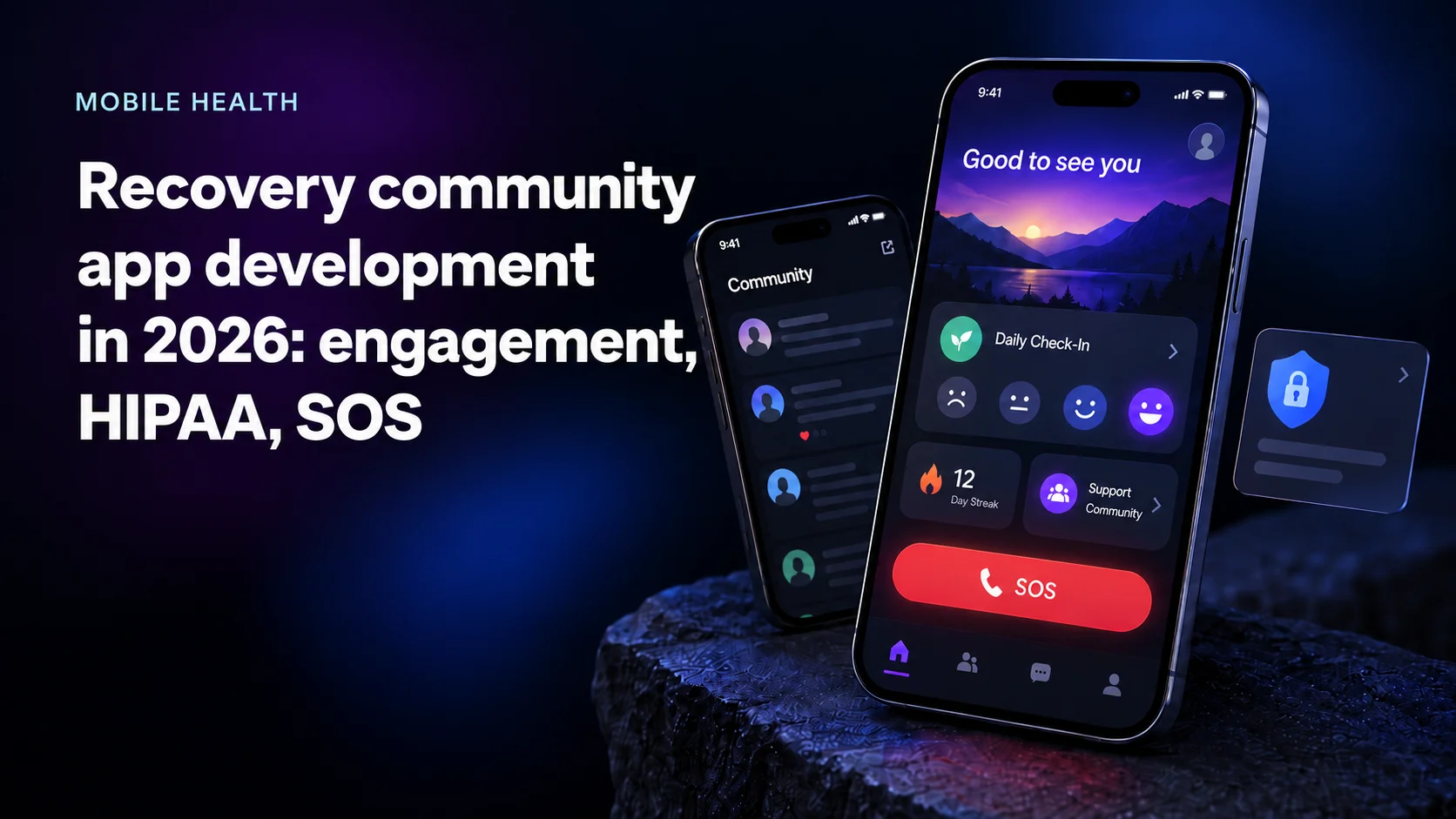
TL;DR
Recovery community app development in 2026 asks one product to do two opposite jobs. It must let someone in their early twenties sign up in one tap and log last night in seconds, while keeping the operator inside HIPAA, 42 CFR Part 2 and Apple's moderation rules. SAMHSA's 2025 survey counts 8.6 million young adults with a substance use disorder, and only 9.6% of young adults who needed treatment received it. For many of them the app is the first door.
- Since February 16, 2026, Part 2 records fall under HIPAA breach notification and HIPAA penalties.
- Apple clarified guideline 1.2 on October 16, 2026: unfixed moderation failures in apps with member posts can now count against its Developer Code of Conduct.
- Social login works if the identity SDK sends no ad events; the FTC's Monument case began with those events.
- An iOS 14.1 floor rules out current React Native. Flutter or native code keeps it.
Why recovery apps are won or lost in the first week
Young adults carry the heaviest load. In SAMHSA's 2025 National Survey on Drug Use and Health, 23.8% of people aged 18 to 25, or 8.6 million, had a past-year substance use disorder, the highest share of any age group. Among those who needed treatment, young adults were the least likely to get it: 9.6%.
Apps lose people fast. A 2019 JMIR analysis of 93 popular mental health apps found a median 30-day retention of 3.3%. Peer-support apps showed a median daily open rate of 17.0% against 4.0% across all apps, though only two were in the sample. Read that as a hint: people come back for other people.
For many members the phone is the whole connection. Pew found in its 2025 survey that 27% of adults aged 18 to 29 own a smartphone but have no home broadband.
That sets the brief: every shortcut toward a community that feels like its members' own runs into a rule.
Two 2026 dates that changed the build
February 16, 2026 was the compliance date of the 2024 Part 2 final rule. For a federally assisted substance use program, Part 2 records now fall under the HIPAA Breach Notification Rule and HIPAA's civil and criminal enforcement. One consent can cover all future treatment, payment and health care operations, while SUD counseling notes need a consent of their own. HHS also states that segregating Part 2 records is not required, so separate storage is now a design choice.
October 16, 2026 is the second date. Apple revised guideline 1.2 to spell out which apps it covers and to warn that failing to put safeguards in place, or to fix violations after notice, may breach the Developer Code of Conduct. The current text names social media apps and requires a filter for objectionable material, a way to report content with timely responses, the ability to block abusive users, and published contact information. It lists random or anonymous chat among the experiences that do not belong.
The third date has not come. HHS proposed on January 6, 2025 to make encryption of ePHI and multi-factor authentication required. As of October 2026 no final rule has been published, and encryption is still addressable under 45 CFR 164.312. Build to the proposal anyway. Added after launch, encryption means migrating every record.
How we built this guide
Three rules apply to everything below.
- Regulatory and platform facts come from HHS, the FTC, SAMHSA and the platform owners directly.
- Engineering examples are projects we publish as case studies, linked so you can check them.
- Where we publish our own numbers, any group with fewer than three data points is not published.
One disclosure. Mercury Development builds custom healthcare software to HIPAA and GDPR requirements, so we have a stake in the build side. Guides that rank for this topic, such as Sidebench's behavioral health apps guide, cover clinical platforms well and give peer support communities a line.
Engagement versus compliance at a glance
| Requirement | What members expect | What the rules require | What we build |
|---|---|---|---|
| Sign-up | Google or Facebook in one tap | Apple 4.8: an equivalent private login; in-app account deletion | Social login for identity only, automatic SDK events off |
| Quick log | Seconds, then back to the evening | Apple 1.4.3: nothing that encourages illegal drugs or excessive alcohol | One tap, local save, neutral words |
| SOS and help | Visible on the first screen | Apple 5.1.5: location APIs are not an emergency service | 988 and 911 by phone, location message to chosen contacts |
| Moderation | Privacy among peers | Apple 1.2 and Google Play: filter, report, block | Pseudonymous handles on verified accounts, flag queue |
| Encryption | Nothing visible | HIPAA 164.312; Part 2 breach rules | Encryption at rest and in transit, keys held apart |
| Device reach | Old phones, shared computers | Program floors such as Android 9 and iOS 14.1 | Flutter or native apps plus a web client |
One-tap sign-up without telling an ad platform about recovery
One recovery operator we build for, whose clients are mostly in their twenties and early thirties, asked for Google and Facebook sign-in for a plain reason: every extra hoop at sign-up costs adoption. The question is what the login SDK does besides logging people in.
Apple's guideline 4.8 says an app that uses Facebook Login or Google Sign-In for the primary account must also offer an equivalent option that limits data to name and email, lets the user hide the email and collects nothing for advertising without consent.
Integrate Facebook Login on iOS and certain App Events are logged automatically unless you turn that off, and app installs and launches are among them. In a recovery app, an install event tied to a device tells an ad platform that this person installed a recovery app.
That is how the FTC's Monument case started. The online alcohol treatment service ran support groups and community forums, promised confidentiality, and sent events with names such as "Paid: Weekly Therapy" to advertising platforms along with emails and IP addresses. The FTC says data on as many as 84,000 users went out, and the proposed order carries a $2.5 million civil penalty under the Opioid Addiction Recovery Fraud Prevention Act, suspended for inability to pay. HHS's tracking guidance adds the HIPAA side: information a regulated entity's app collects is generally PHI, and a tracking vendor needs a business associate agreement before it receives any.
Our setup: social login carries identity and nothing else. FacebookAutoLogAppEventsEnabled is false in Info.plist, with the matching manifest flag on Android, no ad SDK ships in the binary, and product analytics runs under a BAA with event names that say nothing about health.
Logging a night out in seconds
The same operator described the moment the tracker serves: someone at a party, or waking up the next morning, who wants to record what they used within a couple of seconds and get back to the day. Its executives turned down screens that looked plain or too much like Facebook, and named a competitor's chart-heavy app as the look to avoid.
- One tap from the home screen opens the log, with the last entry pre-filled.
- Entries save on the device and sync later, the pattern we built for Shots, a social network for teenagers that keeps user actions offline and synchronizes once the connection returns.
- Monthly views read as sentences before they read as charts.
- Words record and never celebrate. Apple's guideline 1.4.3 rejects apps that encourage illegal drugs or excessive alcohol, so there are no streaks for using days.
- Reminders stay generic. Guideline 4.5.4 says push notifications should not carry sensitive personal information, and "log your drinks" on a lock screen is exactly that.
SOS and help on the first screen
The same team's sharpest feedback was about placement: the SOS button, the staff chat and the map of its centers were buried. The CEO wanted SOS as a real button for one case in particular, a young woman at a party who feels unsafe and needs a ride or her people. Build it as a screen that works before anything else does.
- Crisis lines work signed out. The 988 Lifeline answers by phone, text or chat around the clock through more than 200 local centers and has received more than 25 million contacts since launch. A tel: link needs no account and no analytics.
- Trusted contacts get a location message. The Mayday safety app we built sends distress signals to preconfigured contacts and an all-clear to family once the user is out of danger; in recovery the pair becomes "come get me" and "I'm safe".
- Location goes to friends, and emergencies go to 911 and 988 by phone. Apple's guideline 5.1.5 says location APIs should not be used to provide emergency services.
- The facility finder asks for location only when tapped and accepts a typed address if the member declines, as guideline 5.1.1(iv) asks. The operator's own centers come first, then SAMHSA's FindTreatment.gov locator.
- Staff chat shows its hours and routes to 988 when nobody is on shift.
Moderation that passes App Review and clinical review
Apple's guideline 1.2 is covered above. Google Play's user generated content policy adds that users accept your terms before they post, and that direct messaging comes with in-app blocking.
The hard part is anonymity. Our client wanted members to post anonymously and, in the same conversation, worried about bots and fake accounts. Apple lists random or anonymous chat among the experiences that do not belong. Our answer is pseudonymous to peers and accountable to moderators: every handle sits on a verified account, peers see the handle, staff see the account.
- Flagged posts land in a web admin queue, highlighted, with the reporter's reason attached.
- Clinicians publish articles and videos from the same admin, kept apart from member posts.
- Every block and removal goes to an audit log, which 45 CFR 164.312 asks for anyway.
- AI screens the volume. A moderation system described on our AI agents page reviewed 95% of submissions automatically with acceptable confidence, and one moderator with AI handled 6,000 reviews a day against 300 fully manual ones. Read that as a throughput figure, not a clinical one: in recovery, posts about self-harm, overdose or drug sales always go to a person, and the model runs under a BAA whenever posts can contain PHI.
How to write the store listing itself is covered in our guide to App Store approval for healthcare apps.
Encryption that keeps a lost device out of the breach log
HHS's breach guidance treats electronic PHI as unusable to outsiders when it is encrypted to the HIPAA standard and the key has not been compromised, with keys kept on a device or at a location separate from the data. Data at rest follows NIST SP 800-111; data in motion follows NIST SP 800-52 for TLS.
- Keys live in a managed key service, never beside the database or inside the app bundle.
- Community posts stay server-side encrypted with operator-held keys, so moderators read them under audit.
- Direct messages are the real choice. End-to-end encryption hides them from the operator, so moderation depends on members reporting messages from their own devices. It does not take your storage vendor out of HIPAA: HHS says a cloud provider storing encrypted ePHI is a business associate even without the key.
Since February 16, 2026 a breach of Part 2 records follows the HIPAA Breach Notification Rule, so a substance use program carries the same notification duties as any HIPAA covered entity.
Android 9, iOS 14.1 and the member without a phone
One peer-support procurement we reviewed set the floor at Android 9, iOS 14.1 and a fully optimized web version, because some participants may not be able to afford a smartphone. That one line decides the framework.
React Native 0.76 raised its minimum to iOS 15.1 and Android 7, so a current React Native app cannot install on iOS 14.1. Flutter 3.44 supports iOS 13 to 26 and Android API 24 to 36, which covers both floors. The 1in4 app we built, with community forums, private chat and health tracking, runs on Flutter. Native Swift and Kotlin cover them too, with two codebases.
The web client is the part teams skip. Make it a progressive web app on the same account, with the same SOS screen, so a member whose phone is broken or cut off can continue from a library or shelter computer. Shared machines need short sessions and automatic logoff, which 164.312 lists as addressable.
How the frameworks compare on device floors and native access is in React Native vs Flutter vs native for BLE apps.
HIPAA, Part 2 or the FTC: which rules your app answers to
Who runs the app decides the law. The encryption checklist barely changes.
- A treatment provider that is a HIPAA covered entity, or a developer handling PHI on its behalf, works under HIPAA. HHS's health app scenarios make that developer a business associate.
- A federally assisted substance use program adds Part 2 for its records.
- A nonprofit app with no provider behind it usually sits outside HIPAA and under the FTC's Health Breach Notification Rule, amended effective July 29, 2024.
- Any substance use disorder treatment service also answers to the Opioid Addiction Recovery Fraud Prevention Act for what it promises users, as Monument learned.
Cost bands and timelines for the wider category are in our mental health app development guide.
What our behavioral health requirement records show
Counted by hand in October 2026 across our requirement records for recovery communities, peer support platforms and digital therapeutics for substance use disorders. Record counts stay unpublished under our client agreements. Four patterns are large enough to publish.
- Every one targeted both iOS and Android.
- Every one named a data protection requirement: HIPAA compliance, encryption or a set storage path for patient data.
- Every one needed a second surface next to the member app, for moderation and publishing, study administration or research reporting.
- None named a backend stack or a hosting environment.
A fifth pattern, app store wording limits for substance use content, had fewer than three data points, so it is not published here.
The last finding is the one to act on. Buyers specify the experience and the compliance label, and leave the architecture that decides whether both hold to the vendor. Ask about identity SDKs, key storage and the report queue in the first call.
Why the SOS screen and the report queue ship in sprint one
Opinion, stated plainly: we would rather ship a plain feed with a working SOS screen, a report queue and clean event names than a polished feed without them.
The reason is reversibility. A dark theme takes a sprint. Data an SDK already sent cannot be called back: the Monument order made the company direct third parties to delete what they had received. A first screen designed without SOS tends to stay that way, because later screens are built around it.
One limit: this applies when the app holds health information and lets members talk to each other. A content-only app can start lighter.
Written by Alexey Rodionov, Lead Front-end Developer at Mercury Development since 2020. Alexey is a Google Developer Expert in Web Technologies and a Chromium contributor whose code ships in Chrome DevTools, Google's Bubblewrap and Microsoft PWABuilder. The requirement reviews behind this article, where behavioral health requests are read for platform targets, data protection and staff tooling, come from the engineering practice he works in.
Send us your screen list and we will map the data paths
List the screens your members need, who moderates and which systems your clinicians already use. We will come back with the identity setup, the moderation queue, the encryption boundary and the device floor that list implies, plus what can wait until after launch.