
Software project estimation in 2026: how we price healthcare work
TL;DR
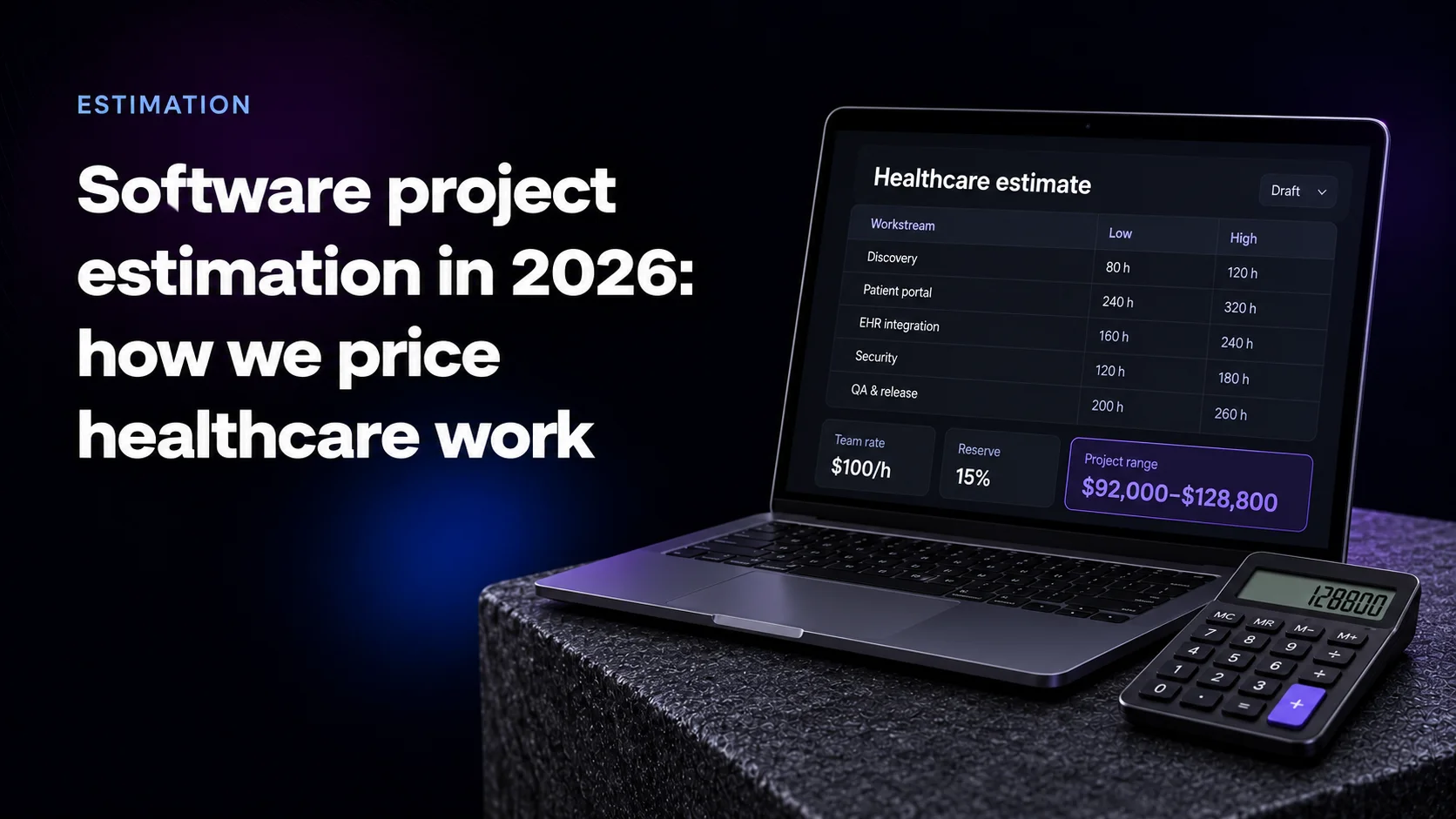
Software project estimation in 2026 turns a healthcare scope into hours, a blended team rate and a stated range, and the range is the honest part. At the concept stage an estimate can miss by 4x in either direction, so a single number before discovery is a sales figure. This guide shows how an agency builds the price, checked against our own healthcare estimate records.
- The price is hours from a bottom-up breakdown, times a blended rate, plus a reserve you can see.
- In our healthcare records, the median ranged estimate had a top about 40% above its bottom.
- HIPAA adds lines a generic quote omits: the business associate chain, PHI environments, one line per integration, older devices.
- In February 2026 METR called its new AI productivity data unreliable, so treat any AI discount in a quote as an assumption to test.
Why healthcare software estimates miss
An estimate is a promise about scope. Most scopes are not finished when the promise is made.
McKinsey found that large IT projects, those with budgets above $15 million, ran 45% over budget while delivering 56% less value than predicted. Timing explains much of it. Construx's cone of uncertainty puts an estimate made at the initial concept stage anywhere from 4x high to 0.25x low, a 16x spread.
Healthcare widens the cone in specific places. The data cannot leave the client's environment, so the vendor estimates against a description of it. The EHR and the device SDK belong to someone else. Clinical sign-off adds review cycles nobody counted.
Buyers feel this as fear of the number moving. One wrote to us before any discovery: "I am hoping that the cost estimate doesn't change." The way there is to fix the scope first.
February 2026: the AI productivity number was withdrawn
For most of 2025 one study framed the argument about AI and estimates. METR's randomized trial of experienced open-source developers found that tasks took 19% longer with AI tools, with a confidence interval of +2% to +39%.
On February 24, 2026, METR published an update on its follow-up experiment. Developers who returned from the first study showed an estimated speedup of 18%, with an interval from 38% faster to 9% slower. Newly recruited developers showed 4%. METR called the new data an unreliable signal: more developers declined to work without AI, and 30% to 50% of those surveyed held back tasks they did not want to do by hand. The authors think developers are likely faster now. They cannot say by how much.
That should shape your quote. We estimate with the tools our team already uses, calibrated on its recent sprints, and apply no blanket AI discount. In healthcare the hours AI cannot shrink are review, test evidence and security sign-off. If a vendor cuts hours "for AI," ask which delivery data supports the cut.
How we built this guide
- Method and benchmark figures come from the primary source, linked in place.
- Our own figures come from healthcare negotiation estimates and pipeline records, counted by hand, no client named.
- Any group of our own data with fewer than three data points is not published.
- Where we combine two public numbers, the arithmetic is labelled as ours.
One disclosure. Mercury Development sells healthcare software development and has built custom software since 1999. Read the recommendations as a vendor's.
Four estimation methods at a glance
| Method | Use it when | What you get | Where it breaks in healthcare |
|---|---|---|---|
| Analogous | You need a budget envelope at the idea stage | A band taken from similar past projects | The past app had no PHI or a different EHR |
| Parametric | Work repeats in countable units: screens, reports, endpoints | Unit count times historical hours per unit | Integrations are not interchangeable units |
| Bottom-up | Discovery has produced a sized backlog | Hours per backlog item, rolled up by role | It misses work nobody wrote down, such as audit logging |
| Three-point | A line carries real uncertainty | Optimistic, most likely and pessimistic hours | It is only as honest as the pessimistic column |
Teams combine them. An analogous band opens the budget talk, bottom-up replaces it once the backlog exists, and three-point sizing covers the risky lines inside it, usually weighted as (O + 4M + P) / 6. Story points tell a new client little about money until converted through measured velocity.
From hours to a price: what sits inside the rate
The arithmetic is hours per role times the rate for that role. The argument is always about the rate.
Start with what an engineer costs. The BLS put the median US software developer wage at $135,980 in May 2025, and the median for QA analysts and testers at $104,300. Wages made up 70.0% of private-industry employer compensation costs in June 2026. By our arithmetic, over a 2,080-hour year a median developer costs an employer about $93 an hour, before paid leave and time between projects, and before overhead or margin. An agency rate covers all of it, which is why it sits well above salary divided by working hours.
Team mix moves the total more than any single rate. In our records, adding a business analyst and a UX designer to a weekly healthcare team raised its weekly cost by about 45%. Often that is the right money, since analysis is cheaper than rework. A quote should show it.
QA belongs on its own line. We staff it from a bench of 100+ dedicated QA engineers, because in healthcare test evidence is a deliverable a security reviewer reads.
The healthcare lines a generic estimate leaves out
These lines rarely look like features, so feature lists skip them.
- The business associate chain. HHS's sample agreement provisions apply the same requirements to contracts between a business associate and its subcontractors. Every service that touches PHI, from hosting to crash reporting, either signs or gets designed out. Both take hours.
- PHI environments. Separate test data, access reviews and audit logs are environment work, priced once and maintained every sprint.
- One line per integration. An EHR, a device SDK and a payer API each need their own sized line. Our EHR integration MVP guide covers how to scope the first one.
- Devices and OS versions. In our records, supporting one older Android version added 30% to the hours of a build.
- Compliance labels. "HIPAA compliant" is not a line item until it is broken into controls. Our comparison of healthcare compliance standards shows what each one asks for.
How a regulated device line splits into estimate rows is shown in our breakdown of IEC 62304 compliance cost.
Contingency: in the open or buried in every task
Every estimate carries a reserve. The question is where you can see it.
Padding each task hides the reserve. Nobody can discuss it or release it when the risk does not happen. A separate line, sized from the gap between the most likely and pessimistic values of the risky items, can be tracked and handed back.
Contract type changes who holds the reserve. Under a fixed price the vendor absorbs variance, so it prices toward the pessimistic case. Under time and materials you hold it and pay hours as worked. Our guide to the fixed price RFP for healthcare software covers how to split the two.
Evidence narrows ranges faster than negotiation does. After we reviewed one device company's existing code, its estimate moved by about $2,000. A working product is the best input of all: when EyeIC moved its FDA-cleared imaging application from desktop to web, the old version defined the scope, key code was reused to cut cost, and the migration took 3 months.
Which pricing shape fits your project
- An idea with no backlog. Price discovery alone. Our only published prices are for AI agents, where discovery sprints start at $25,000. The estimate inputs checklist lists what to send first.
- A sized backlog with stable scope. A fixed price per milestone, paid on an accepted demo.
- Scope that moves with clinical feedback. Time and materials with a ceiling and weekly burn reporting.
- A live product with a roadmap. A standing team priced per week or month.
To see the same scope priced as three scenarios, from MVP to full program, use our template for scenario pricing for healthcare software.
How to compare two healthcare quotes
Totals are the last thing to compare.
- Put both quotes on hours and roles. A cheaper total with no QA role is a different product.
- List what each excludes: hosting, signed business associate agreements, app store accounts, support after launch.
- Find the contingency. Separate line, or spread through every task?
- Ask each vendor for the three assumptions that would move its number most.
- Ask whether an AI discount is built in, and what data supports it.
- Ask what the range becomes after discovery, and what discovery costs.
If the quotes differ mostly in months, read them with our guide to the software development timeline estimate.
What our healthcare estimate records show
Counted by hand from the estimates we issued in healthcare negotiations, from remote monitoring to behavioral health.
Around 25% of those estimates went out as ranges. The rest were single figures, scope options priced side by side, or a weekly team cost. The median range had a top about 40% above its bottom. The widest, for a device platform still at concept stage, had a top four times its bottom, the cone in miniature.
Around 35% priced an analysis, design or discovery phase separately from the build.
The biggest moves came from scope decisions. Removing a single storefront integration took about $92,000 off a remote monitoring estimate. Adding a mobile client to a web build raised a clinical messaging estimate by about 25%. Buyers asked the same question in different words: "Do you expect the price to drastically increase?" The answer always hung on one open decision.
Where estimates still go wrong
Opinion, stated plainly. Estimates rarely fail on arithmetic. They fail on the assumptions list, the part buyers skim and vendors write in a hurry.
In healthcare the most expensive assumption is that someone else's system behaves as documented. An EHR sandbox that differs from production breaks the number without anyone being careless. We write each such assumption down with an owner, so a miss has a name instead of a blame.
Ranges frustrate budget committees. We still issue them, because a single number at concept stage moves the risk somewhere you cannot see. A range also has a limit: it covers uncertainty in a fixed scope, not a scope that keeps growing. That is what change control is for.
Written by Rob Devereaux, Chief Operating Officer at Mercury Development. Rob has run the firm's operations from Hudson, Ohio since 2019 and has over 20 years of operational and financial experience. The negotiation estimates and pipeline records behind this article's pricing figures sit in the operations he oversees.
Send us your scope or a quote you already have
Share your scope, a backlog or a quote from another vendor. We will reply with the assumptions that drive the price, the lines a healthcare build usually adds, and what a first paid phase would settle.