
Build a SoundCloud alternative for emerging artists: 2026 MVP plan
TL;DR
To build a SoundCloud alternative for emerging artists in 2026, fix discovery first. The player is a solved problem. Finding the next artist in your scene is not, and that is the gap a niche platform can own.
- Ship three surfaces in the MVP: a listener app on iOS and Android, an artist web dashboard, and an admin panel.
- Design navigation around scenes and the people in them, not around single tracks. SoundCloud's own data says listeners who discover tracks through Liked By playlists are over 3x more likely to engage.
- Match what artists already get. SoundCloud Artist Pro costs $99 a year, Audiomack shares 50% of ad and subscription revenue, and Bandcamp keeps 15% of digital sales.
- Charge fans through Apple in-app purchase on iPhone, sell artist plans on the web, and pay artists through a payout service such as Stripe Connect.
The player is solved, the map is not
Every audio app can stream a file. Waveforms, queues and offline caching are commodity engineering in 2026. Nobody leaves SoundCloud because the play button is broken.
They leave because they cannot find anyone. A rapper uploads a track and it lands in a catalog sized for everyone. A listener who loves one underground artist has no clear path to the next five. Founders who come to us describe the same pain in different words: the platform is hard to navigate, and artists are hard to find.
That is your opening. A niche platform knows its genre, its cities and its crews. It can make the path from one artist to the next short and obvious. SoundCloud's Music Intelligence Report 2026 says its listeners play new music nearly twice as much as listeners across the industry. The appetite for new artists exists. The navigation is what you can do better.
SoundCloud now sells downloads at zero commission
On August 26, 2026, SoundCloud announced direct music purchases. Artists set their own prices and sell MP3 and WAV downloads from their profiles, and SoundCloud takes zero commission, according to EDM Sauce. The beta started with roughly 200 US-based Artist Pro creators who have Fan Support turned on, with a wider rollout promised for the fall.
For a founder, this moves the floor. A pitch built on a smaller cut now competes with a cut of zero. Your fee model cannot be the whole reason to switch. Better discovery for a specific scene can be.
The bar a niche platform has to clear
Emerging artists already compare offers. Here is what the main platforms put on the table, from their own pages.
| Platform | What artists pay | What artists get | Catch |
|---|---|---|---|
| SoundCloud | Artist $39 a year, Artist Pro $99 a year | Artist monetizes 2 tracks a month, Artist Pro unlimited | Monetization needs a paid plan and original content |
| Audiomack | Free | 50% revenue share on monetized streams, 85% of Supporters revenue | Authentication, 25 followers and 1k plays before applying |
| Bandcamp | Free | Sales minus a 15% digital or 10% physical revenue share | Payment processor fees of 4 to 6% on top |
SoundCloud's pricing page lists Artist at $39 a year and Artist Pro at $99 a year, and its help center limits monetization to original tracks between 30 seconds and 10 minutes. Audiomack's monetization FAQ asks for at least two uploads, 25 followers and 1k plays before an artist can apply. Bandcamp's fee page drops the digital share to 10% once an artist passes $5,000 in sales.
A new platform cannot outpay these companies per stream on day one. It can make an artist with 40 followers visible to the 400 people who would actually like them.
MVP scope: one scene, three surfaces
A niche audio MVP is three products. Scope only the app, and you meet the other two at launch.
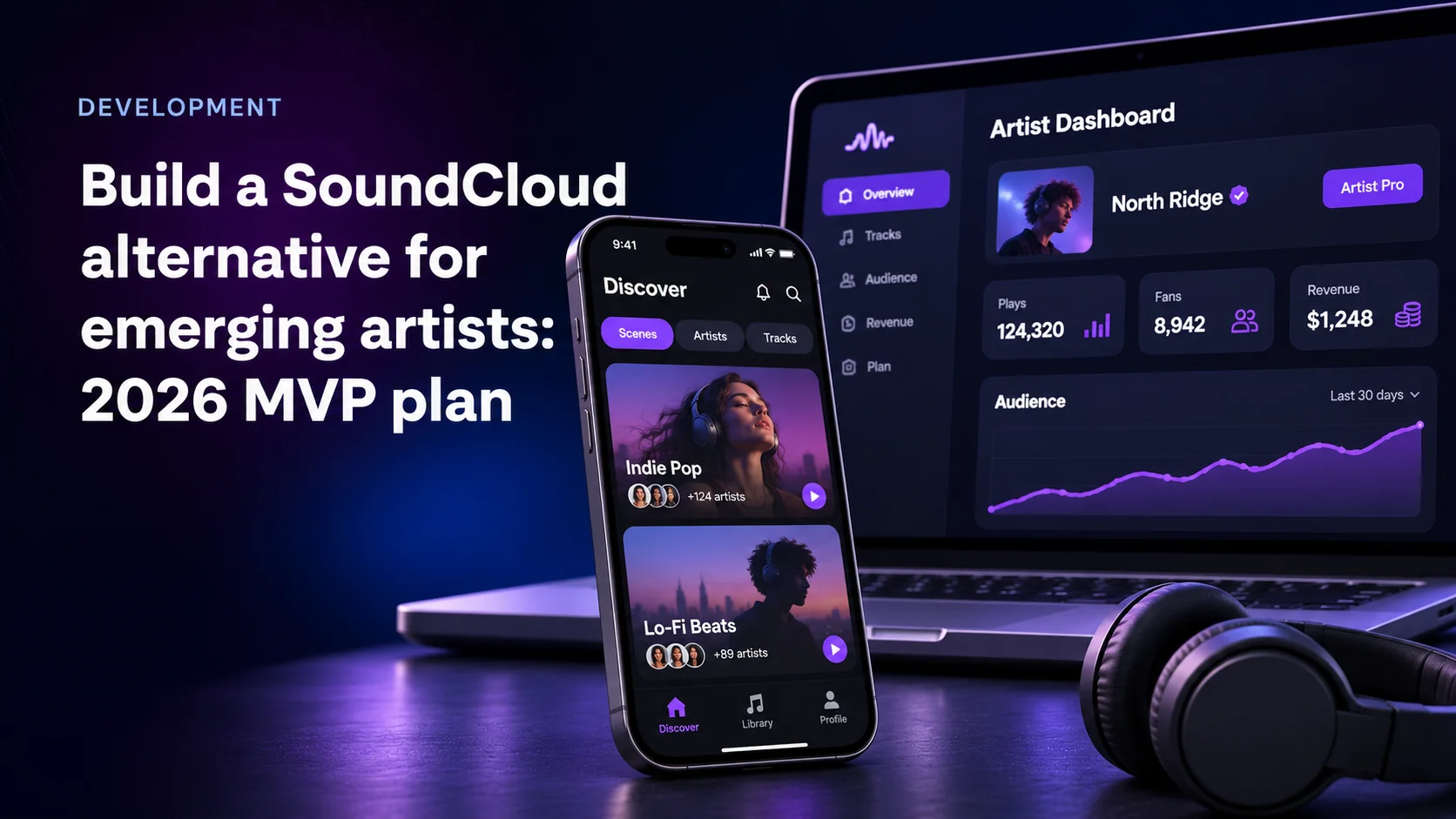
- The listener app on iOS and Android: browse the scene, play, follow, like, share, support an artist.
- The artist web dashboard: upload, tag, edit the profile, see who listens, set up payouts.
- The admin panel: review uploads, handle takedown notices, approve payouts, feature artists, ban spam.
Cut everything else from the first release. Messaging, live audio and AI mastering can wait for proof that the scene shows up. Keep the web player, though. Artists share links, and a link that only opens in an app loses most of the people who click it.
Order the build around the risky parts. Upload and transcoding come first, because everything depends on audio arriving. Discovery comes second, because it is the reason the product exists. Payments come third, once there is something worth paying for.
Discovery UX that makes artists findable
Navigation decides whether an emerging artist gets heard. Four patterns do most of the work.
- Scene-first browsing. Open the app on a scene page: a city, a subgenre, a crew. Every track carries its artist, and every artist page links to the people they play with.
- People as signposts. SoundCloud reports that listeners who discover tracks through Liked By playlists are over 3x more likely to engage on the track. Show listeners what tastemakers they follow have liked.
- Artist pages that work as landing pages. Bio, top tracks, upcoming shows, related artists, and one clear way to support. This is the page an artist sends to a fan.
- Tags the community can trust. Let artists pick from a fixed list of subgenres and locations, then moderate it. Free-text tags turn into spam within weeks.
Measure discovery directly: how many new artists a listener plays each week, how many they follow, and how many new artists get their first 100 plays. Those numbers tell you if the map works.
Monetization that works on day one
Money flows in two directions: from fans to the platform, and from the platform to artists. Each direction has its own rules.
Fans who pay inside an iPhone app pay through Apple. The App Review Guidelines require in-app purchase for subscriptions and premium features sold in the app (3.1.1), allow in-app purchase currencies for tipping content creators, and let US storefront apps link out to other ways to pay. Apple's commission is 15% under the App Store Small Business Program for developers with up to 1 million USD in proceeds. Google Play's US alternative billing program charges a 10% service fee on auto-renewing subscriptions.
Artists pay on the web. Sell artist plans and promotion in the dashboard, where no app store sits in the purchase. Audiomack's FAQ shows why this matters: the same Support Badge costs 2.9% + $0.30 in fees on the web and 30% on iOS.
Paying artists out needs a marketplace payout service. Stripe Connect charges $2 per monthly active account plus 0.25% + 25¢ per payout when the platform sets its own pricing. Keep your own ledger of what every artist earned, and pay on a delay that covers your refund window.
Start with fan support: tips and a monthly supporter tier per artist. It is easy to explain and needs no streaming royalty math. SoundCloud's fan-powered royalties send each listener's revenue only to the artists that listener played, which is worth copying later once you have paying subscribers.
Uploads, rights, DMCA agent
If artists upload their own music, your terms must say they own it and grant you the right to stream it. Catalog music from labels is a separate world of licenses. Keep it out of the MVP.
User uploads also bring infringement claims. US law gives online platforms a safe harbor if they designate an agent with the Copyright Office. The DMCA Directory FAQs set the fee at $6 per designation, and the designation expires three years after registration. Let it lapse and you risk losing the safe harbor. Build the admin side to match: a takedown form, a queue, a counter-notice flow and a repeat-infringer rule.
What music founders bring us
These findings come from our own presales records for consumer music and social video products, counted by hand. They describe buyers who came to us, not the market.
Around 65% wanted monetization in the first release. Around 85% needed a web surface next to the mobile app: a website, an artist portal or an admin panel. Around half described the product by naming an existing platform it should beat. And around half came in with a first release larger than their budget or timeline could carry.
The first signed piece of work was small. The median first contract in this group was $10,000. Founders bought a defined first step before committing to the whole platform. That matches what we recommend: pay to cut the scope before you pay to build it.
What MuzicSwipe taught us about emerging artists
MuzicSwipe is a music discovery app built to help emerging artists connect with new audiences. Artists upload 15-second genre-tagged clips. Listeners swipe to rate them, and several likes create a match that opens full tracks and the artist's profile.
Mercury took the product from concept to launch on mobile and web, covering design and full-stack development, media storage with CDN delivery, a custom recommendation and tagging system, and analytics with A/B testing. The analytics track clip completion rates, match frequency and session duration.
Two lessons carry over to any SoundCloud alternative. Short previews let a listener judge an unknown artist fast. And tags plus events give you a recommendation engine before you have a big catalog. For the payment side of a swipe model, see our guide to a swipe music discovery app.
Launch one scene before you launch a platform
SoundCloud is huge, and that is its weakness for a newcomer. A generalist alternative has to beat it at everything. A niche platform has to beat it at one thing for one community.
So pick the scene. Recruit its first artists by hand. Make the path from one artist to the next shorter than anywhere else. Charge once listeners come back without being asked. Then add the next scene, using the same three surfaces.
Mercury Development has built apps since 1999, has 500+ engineers, and its apps reach more than 40 million users. If you are comparing vendors, our list of music streaming app development companies ranks six by shipped audio work.
Written by Rob Devereaux, Chief Operating Officer at Mercury Development. Rob has run the firm's operations from Hudson, Ohio since 2019 and has over 20 years of operational and financial experience. The presales records behind this article's buyer section sit in the operations he oversees.
Tell us your scene and we will cut the first release
Tell us which scene you want to serve, who your first artists are, and how you plan to earn. We will come back with a first release across mobile and web, a discovery flow, and the payment setup that fits the stores.