
Top cruise line software development companies in 2026
TL;DR
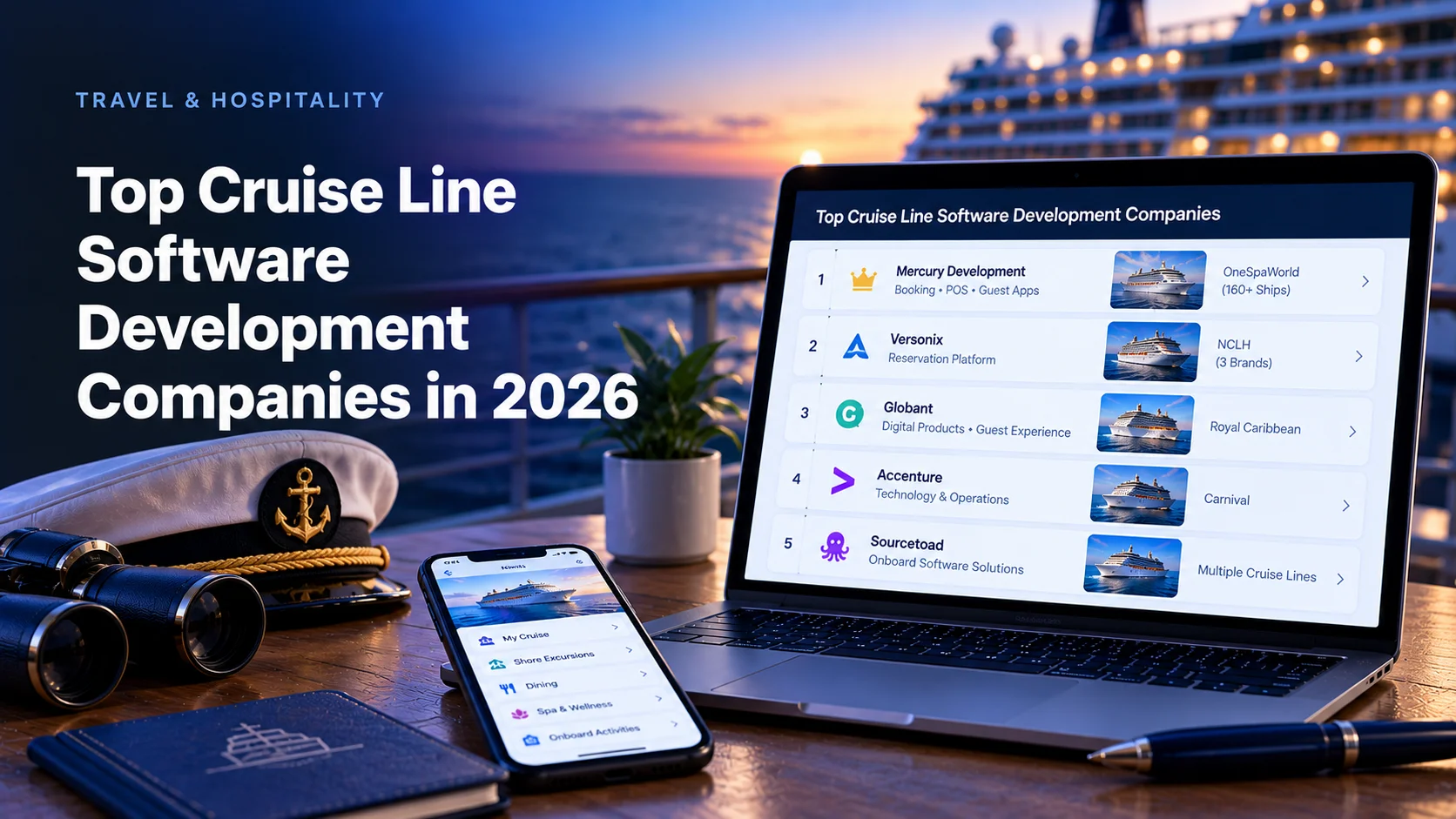
This ranking of cruise line software development companies for 2026 covers the firms cruise lines hire to build or replace booking, reservation and guest software. Ten companies are scored on named cruise work you can check, reservation and distribution depth, shipboard engineering, and who owns the code. Mercury Development ranks first: its spa booking, POS and checkout for OneSpaWorld has run on onboard servers with no internet since 2018 on over 160 ships, and since late 2021 it has built dining reservation, tableside ordering and guest app software for a cruise line under NDA.
- Versonix is the reservation platform pick: on October 22, 2026, NCLH said all three of its brands will run on Seaware.
- Globant and Accenture hold the deepest named cruise programs, with Royal Caribbean and Carnival.
- In the three current cruise software rankings we audited, 4 of 48 entries name a cruise line.
- Every card carries a watch-out, ours included.
Cruise booking in 2026 runs through advisors, apps and one reservation core
Demand is not the problem. CLIA's 2026 State of the Cruise Industry report, as reported by Seatrade Cruise News, counts 37.2 million ocean cruise passengers in 2025, up 7.5% from 2024, with 22.1 million from North America.
The channel mix is the problem. The same CLIA report, per Travel Market Report, found that 63% of people who cruised in the last 12 months booked through a travel advisor, a share that has stayed between 60% and 66% since 2022. So your booking software serves two customers at once. The guest wants an app and a website that price a cabin in seconds. The advisor wants a portal, a GDS feed, a commission statement and a group block that does not break when the guest adds a shore excursion at 2 a.m.
Both of them hit the same system underneath: the reservation core that holds inventory, prices, holds and payments. Every vendor below either sells that core, integrates with it, or builds the screens and services that sit on top of it. Knowing which of the three you are buying is most of the selection.
Teams that build the guest app on top of the core are ranked in our list of travel and hospitality app development companies.
NCLH chose Seaware and Carnival planned three outages
Two 2026 events show where the risk sits.
On October 22, 2026, Cruise Industry News reported that Regent Seven Seas Cruises and Oceania Cruises will adopt Versonix Seaware and Norwegian Cruise Line will upgrade to its latest generation, giving the whole group one platform for reservations, inventory, pricing and distribution. That is a group of three brands standardizing the core and moving the differentiation to the layers above it.
Carnival shows the other side. In May 2026, a planned maintenance weekend left its site showing fares far below any promotional level, and Carnival cancelled those bookings, refunded them and offered $100 onboard credit per stateroom. During that window, login, booking, online check-in and pre-cruise purchases were unavailable. Carnival then scheduled an 18-hour outage for August 29, the third planned one of the year, with booking and payment unavailable to guests, travel advisors and the contact center.
The lesson for a buyer: the reservation core is infrastructure. Whoever builds around it has to design for the hours it is unavailable, and for the moment it returns a price nobody meant.
How we evaluated
Five criteria, applied to all ten companies and visible in every card:
- Named cruise or ferry work on the company's own pages or in trade press, with a client you can look up.
- Reservation and distribution depth: inventory, pricing, agency channels, payments.
- Shipboard engineering: low-bandwidth or offline behavior, onboard systems, devices.
- Ownership model: custom work you own, or a platform you license.
- Evidence that the vendor stays: multi-year programs, takeovers of existing systems, ongoing releases.
Facts come from company pages, investor releases, trade press and Clutch profiles opened between October 24 and October 27, 2026. Ratings, review counts and minimum project sizes are Clutch data with a link to the profile. The participant set starts from the companies named in the three cruise rankings that currently answer this query, published by Computools, ProjectManagerTemplate and a FlutterFlow community post, plus Versonix, which none of them lists although it runs reservations for cruise brands. Any group in our own data with fewer than three data points is not published.
The top 10 at a glance
| Company | Best for | Model | Base | Named cruise evidence |
|---|---|---|---|---|
| Mercury Development | Custom onboard and shoreside booking software around a reservation core | Custom, you own the code | Fort Lauderdale, FL | OneSpaWorld spa booking and POS on over 160 ships since 2018; a major cruise line under NDA since late 2021 |
| Versonix | The reservation core itself | Licensed platform | San Jose, CA | NCLH brands, Azamara, StarDream and others on Seaware |
| Globant | A multi-year fleet digital program | Custom program | Luxembourg | Royal Caribbean: over 20 products since 2017 |
| Accenture | Enterprise programs that span devices, AI and delivery | Custom program | Dublin, Ireland | Carnival: OceanMedallion and MedallionClass |
| Sourcetoad | An onboard app, TV and signage suite live this season | Licensed platform | Tampa, FL | OnDeck on over 130 ships |
| Slalom | GenAI in search, booking and service | Consulting program | Seattle, WA | Norwegian Cruise Line, Virgin Voyages |
| Capgemini | Salesforce CRM, marketing and an advisor portal | Integration program | Paris | Unnamed global cruise and travel company |
| Endava | One booking site across several brands | Custom program | London, UK | Scenic Group, including Emerald Cruises |
| GP Solutions | Reservation engines and GDS plumbing | Custom on travel components | Unterschleissheim, Germany | Tallink ferry booking |
| Launch Consulting | Edge-capable guest platform engineering | Custom program | Greater Seattle area | Carnival: Ocean Medallion |
1. Mercury Development
Mercury Development ranks first because it builds the booking software cruise guests and crew actually touch, and two long-running cruise programs show it working at fleet scale. It is custom work the client owns, built around whatever reservation core the line already runs.
The first program is OneSpaWorld, which describes itself as the operator of health and wellness centers onboard cruise ships and which Mercury's portfolio index lists as a client. Mercury built the software the spa staff run on board: ReactJS web applications deployed to onboard servers with no external internet connectivity, used on Android tablets in kiosk mode or on ordinary computers without touch input. They cover scheduling and booking of spa procedures, guest intake forms branded and localized into several languages, the activity schedule, staff and guest directories, and a docket, POS and checkout that calculates prices dynamically, including personalized discounts and offers from both OneSpaWorld and the cruise lines. Admin tools handle voyage setup, reporting, monitoring and ship-specific configuration, and middleware connects the system to OneSpaWorld's ship-side backend, its shore data exchange and APIs specific to each cruise line. It has been maintained in production since 2018 and runs on over 160 ships operated by multiple cruise lines.
Around that core sit the booking pieces a cruise buyer will recognize. A guest-facing pre-booking site and a calendar widget that cruise lines embed on their own websites, so guests book treatments before sailing instead of calling a contact center. An activity booking module that books one or several guests and opens a waitlist when an event is full. Class sign-ups that read the guest's RFID cabin key through a reader paired with the tablet.
The second program is for a cruise line that Mercury cannot name under NDA and has run since late 2021. It covers React Native food and beverage apps; tools for dining hosts and venue managers to handle reservations, guest profiles, staff notes, booking history and check-in; tableside ordering with table management, order status, kitchen and bar integrations and guest allergen profiles; and backend components that aggregate data and functions from dozens of legacy microservices behind a new middleware for passenger apps. The passenger app was rebuilt on React Native rather than ported, with pre-cruise readiness, boarding pass, ship map, guest and crew chat, dining reservations, a journey planner and payment methods, and ADA and PCI DSS as release gates.
Outside cruise, the back-office record is long. For Precision Practice Management, Mercury built a rules-driven claims workflow outside four third-party billing platforms; the page says it raised claims worked by 80% without new staff, and Mercury has extended it since 2006. The Grant's app added a payment gateway integration for client-side PCI compliance.
Best for: cruise lines and onboard concessionaires that need custom booking, ordering, POS or guest software that works on the ship's network, or advisor and back-office tools around an existing reservation core, with the code owned by the client. Facts: Founded 1999; HQ Fort Lauderdale, FL, with offices in Miami, Chicago, Cleveland, Belgrade and Buenos Aires; 500+ engineers, more than 1,500 completed projects and more than 40 million users of its applications; all work is work-for-hire and the customer owns the code and all underlying IP; Clutch 5.0 on 34 reviews, $25,000+ minimum. Watch-out: neither cruise program has a public case page and the second client cannot be named, so the reference comes through a call rather than a URL. Mercury does not sell a reservation system; for the core itself, start with Versonix.
2. Versonix
Versonix is the reservation platform in this ranking: the only participant whose core product is a cruise reservation system run by named cruise lines. Its Seaware platform, per Seatrade Cruise News, has powered reservations for more than 20 million passengers and 100 ships a year, and works as one point for OTA, GDS, B2B, B2C and contact center channels. Azamara, Atlas Ocean Voyages, The Ritz-Carlton Yacht Collection and StarDream Cruises are named Seaware users, and NCLH is extending it to all three brands. When StarDream Cruises went live in May 2026, Seatrade described one platform that unifies reservations, inventory management, CRM, distribution and operational automation, with dynamic pricing tools and APIs. A 2018 Seatrade report describes a Versonix patent application for selling inventory from ships and remote ports without continuous connectivity between locations.
Best for: a cruise line replacing its reservation system, or a new brand that needs inventory, pricing and agency distribution from day one. Facts: Founded 1986 and based in San Jose, CA, per its G2 profile; no Clutch profile found. Watch-out: you license Seaware rather than own it, so your booking flow follows its release cycle. It is a platform, not a team that will build your guest app.
3. Globant
Globant runs the most detailed named cruise program here. Its case study Creating a smart venue on the high seas says Royal Caribbean Group and Globant started working together in 2017 and have collaborated on over 20 different products, with a team that reached nearly 400 people. The booking-adjacent scope covers online check-in, documents before the terminal, shore excursions, specialty dining and onboard spend, alongside Muster 2.0 and kids-club registration that now takes nearly 80% less time.
Best for: a large line that wants one partner across guest, crew and safety products for years. Facts: Founded 2003; HQ Luxembourg per its investor FAQ; Clutch shows no reviews yet and a $5,000+ minimum. Watch-out: the cruise record is one client told through a self-published PDF, and nothing we opened describes how its apps behave when the ship's link drops.
4. Accenture
Accenture's cruise record is Carnival. In 2019 Carnival named it Premier Innovation Partner for the MedallionClass experience. Per the release, its design teams worked on the wearable OceanMedallion, its AI group built an experience intelligence engine for personalization, and its technology group supplied technical architecture, software development, testing and delivery. Carnival said Accenture worked from ideation through implementation. Program figures in the same release: 95% of boarding steps done on mobile before arrival, and boarding wait cut by more than 90%.
Best for: a cruise group running an enterprise program that combines devices, data, AI and long-term delivery. Facts: Founded 1989; HQ Dublin, Ireland, per Wikipedia; about 814,000 people and about $74 billion in fiscal 2026 revenue per its fiscal 2026 results. Watch-out: the named cruise work dates from 2019 and was shared with other partners, including Launch Consulting below. A mid-size line will be a small account here.
5. Sourcetoad
Sourcetoad is the cruise specialist. Its About OnDeck page says it developed the cruise industry's first onboard passenger app in 2010 and lists Viking, Virgin Voyages, Explora Cruises, Ritz-Carlton Yacht Collection, NorthLink Ferries and Orkney Ferries, and its own article puts the technology on over 130 ships worldwide. The Cruise Director Platform syncs content across a fleet with bandwidth-aware replication and delivers notifications with no internet required.
Best for: a line that wants a proven onboard app, in-cabin TV and signage suite live this season. Facts: Founded 2008 per Clutch; HQ Tampa, FL; Clutch 5.0 on 9 reviews, $25,000+ minimum. Watch-out: OnDeck is licensed software, so you rent the codebase, and Clutch puts the company at 10 to 49 employees, small for a fleet-wide dependency.
6. Slalom
Slalom's cruise work sits in the booking funnel. For Norwegian Cruise Line it built Nora, a GenAI itinerary assistant on OpenAI and AWS that started as a four-week sprint. NCL guests who use it are 58% more likely to enter the booking funnel, and the value of their bookings rises 16%. For Virgin Voyages it built a GenAI digital human on Salesforce that cut call center escalations by more than 20%.
Best for: a line that wants measurable AI in search, booking and service on top of its existing core. Facts: Founded 2001 per Clutch; HQ Seattle, WA; Clutch 2.0 on 1 review, $100 to $149 per hour. Watch-out: nothing published touches the reservation system itself, offline behavior or the ship.
7. Capgemini
Capgemini's cruise case is the advisor and CRM layer. For an unnamed global cruise and travel company launching a new brand, it built a customer engagement platform on Salesforce: Marketing Cloud for campaigns across the cruise lifecycle, Sales Cloud integrated with the reservations engine, Service Cloud for customer service, and Community Cloud as a travel agency portal, plus a next best action engine and integrations with reservations, onboard systems and the data warehouse.
Best for: a line whose booking problem is the CRM, marketing and advisor portal wrapped around the reservation system. Facts: Founded 1967; HQ Paris, France, per Wikipedia; over 420,000 team members in more than 50 countries and 2025 revenues of €22.5 billion per its Q1 2026 revenue release. Watch-out: the client is not named, the case dates from 2019, and the only result reported is strong online bookings before the inaugural cruise.
8. Endava
Endava's cruise case is a booking site. For Scenic Group, which includes Emerald Cruises, it built one online platform to research, book and manage trips across five brands in 15 markets, with a shared design system and a visual trip planner for pre-departure upsell. Endava says the platform paid for itself within the first four weeks.
Best for: a multi-brand cruise group that needs one booking front end and one design system. Facts: Founded 2000 per Clutch; HQ London, UK; headcount 11,225 at March 31, 2026 per its third quarter fiscal 2026 results; Clutch shows no reviews yet. Watch-out: the evidence stops at the website. Nothing published covers onboard apps, offline behavior or the reservation core.
9. GP Solutions
GP Solutions builds reservation plumbing for travel companies. Its Cruise Booking Software page lists rule-based cabin assignment, group, multi-itinerary and shared-cabin bookings, scheduling of onboard facilities and combined payment types. The maritime proof is a ferry: for Tallink it built a single-page booking flow, add-on booking, self-service changes and a loyalty program inside the booking system, over 50,000 man-hours. Its About page names it a certified Amadeus development partner and a Sabre Developer Partner Program member.
Best for: a line extending its booking engine, cabin inventory rules and agency distribution. Facts: Founded 2002 per Clutch; HQ Unterschleissheim, Germany; 350+ IT professionals; Clutch 4.9 on 24 reviews, $50,000+ minimum. Watch-out: the cruise page names no cruise line, and the Tallink result it reports is a 1.4% sales increase.
10. Launch Consulting
Launch Consulting is the other named builder on Carnival's Ocean Medallion. Its Carnival case describes wearables for guest identification and boarding, cloud backup that can operate at the edge so service continues when satellite links fail, a digital twin with live analytics on guest and crew activity, and encrypted processing with on-device authentication.
Best for: a line that needs edge-capable guest platform engineering and has already chosen its core systems. Facts: founded in 2005, headquartered in the Greater Seattle area and over 600 team members when The Planet Group agreed to acquire it in 2022; no Clutch profile checked. Watch-out: the case publishes no figures, and booking or reservation work is not on the page.
Which company fits your project
Ranking is one question. Fit is another.
| Project type | Recommended partner |
|---|---|
| Onboard booking, POS or guest software that must work with no internet | Mercury Development |
| Dining reservations, tableside ordering or a guest app rebuild | Mercury Development |
| Custom advisor, guest or crew apps around an existing reservation system | Mercury Development |
| Back-office workflow the reservation system does not handle: commissions, groups, fare rules | Mercury Development |
| Taking over a booking app or portal from another vendor | Mercury Development |
| Replacing the reservation core | Versonix |
| Multi-year fleet program with one partner | Globant |
| Enterprise program across devices, AI and delivery | Accenture |
| Onboard app, iTV and signage, licensed | Sourcetoad |
| GenAI in itinerary search and service | Slalom |
| Salesforce CRM and travel advisor portal | Capgemini |
| One booking site across several brands | Endava |
| Booking engine rules, GDS and agency links | GP Solutions |
| Edge-capable wearable guest platform | Launch Consulting |
What we counted in the cruise rankings and in our own cruise programs
Two counts, both done between October 24 and October 27, 2026.
First, the rankings. We read every entry in the three cruise lists named in the methodology: 20 in Computools, 10 in ProjectManagerTemplate and 18 in the FlutterFlow post, 48 entries in total.
- 4 of the 48 entries name a cruise line: Slalom, Accenture, Launch Consulting and Endava, all in the Computools list. One more, Lloyds Digital in ProjectManagerTemplate, names a Croatian passenger shipping company.
- None of the 18 FlutterFlow entries names a cruise client, and 15 of them carry no link at all.
- Computools appears in all three lists and ranks itself first in its own; Globant and UST appear in two.
- None of the three lists gives a price for cruise software. The FlutterFlow cost section has three tiers and no dollar figures.
- At-sea connectivity is the gap. Computools covers limited internet in its FAQ; of the other 28 entries, only Softeq's mentions offline functionality, and not at sea.
Second, our own record, from Mercury's project records, because a cruise booking system is a long relationship and you should ask any vendor for the same numbers.
The OneSpaWorld program has been in production since 2018 on over 160 ships, and it grew from the first product into adjacent booking work: pre-cruise booking for guests, an embeddable widget for cruise line websites, activity booking and class sign-ups.
Its E-Forms platform replaced paper consultation forms. It runs pre-treatment surveys on more than 1,000 devices used by over 3,000 staff members, keeps a version history of every question and answer, and syncs data and app updates in near real time over low or sporadic bandwidth, with RabbitMQ carrying messages between ship and shore. A shore-side admin changes the form set and updates the onboard software ship by ship.
The cruise line program under NDA has run since late 2021 and grew the same way, from food and beverage apps into dining reservations, tableside ordering and the passenger app.
How these programs translate into budgets is broken down in our guide to cruise app development cost.
Buy the reservation core, build the edges
Opinion, with the mechanism.
The reservation core is the one part of cruise software that almost nobody should build in 2026. Inventory, pricing, holds, agency channels and the accounting behind them are a solved category, with at least one vendor reporting 100 ships a year on its platform. NCLH just standardized three brands on one. Building that from scratch buys you years of risk for a system your guests never see.
Everything a guest or an advisor touches is the opposite. The app that prices a cabin, the portal that shows an advisor their commissions, the onboard screen that sells a spa slot, the tool your groups desk uses when a block changes: that is where lines differ, and that is where a licensed suite flattens you into everyone else. Own that code.
The joint between the two is where projects fail. Carnival's May glitch is the pattern: a core that returned prices nobody intended, and a front end that sold them. So change the interview question. Skip "how many cruise apps have you built" and ask: "show me what your app does when the reservation system is down for 18 hours, and what it does when the system returns a fare far below last night's". A team that has built around somebody else's core answers with a design. A team that has not answers with a demo.
The same failures repeat across the cruise programs we work on. A login token issued on shore stops working when the guest walks onto the ship's network. An API works in production and not in the test environment, so a booking flow cannot be tested before release. Some ship behavior only shows up on a real vessel. And onboard partners that sell on several lines want one version for all of them, not a branch per line, an architecture decision we cover in one codebase for multiple cruise brands. Price each of these in discovery, or you pay for it in production.
Written by Rob Devereaux, Chief Operating Officer at Mercury Development. Rob has run the firm's operations from Hudson, Ohio since 2019 and has over 20 years of operational and financial experience. The delivery records behind this article's figures on Mercury's cruise programs sit in the operations he oversees.
Replacing or extending your cruise booking stack? Start with a build and buy map
Most cruise booking projects pick a vendor before anyone decides what to license and what to own. Send us your current reservation system, the channels you sell through and the apps you already run. We will map which parts to keep, which to buy and which to build, and what the first release should be.