
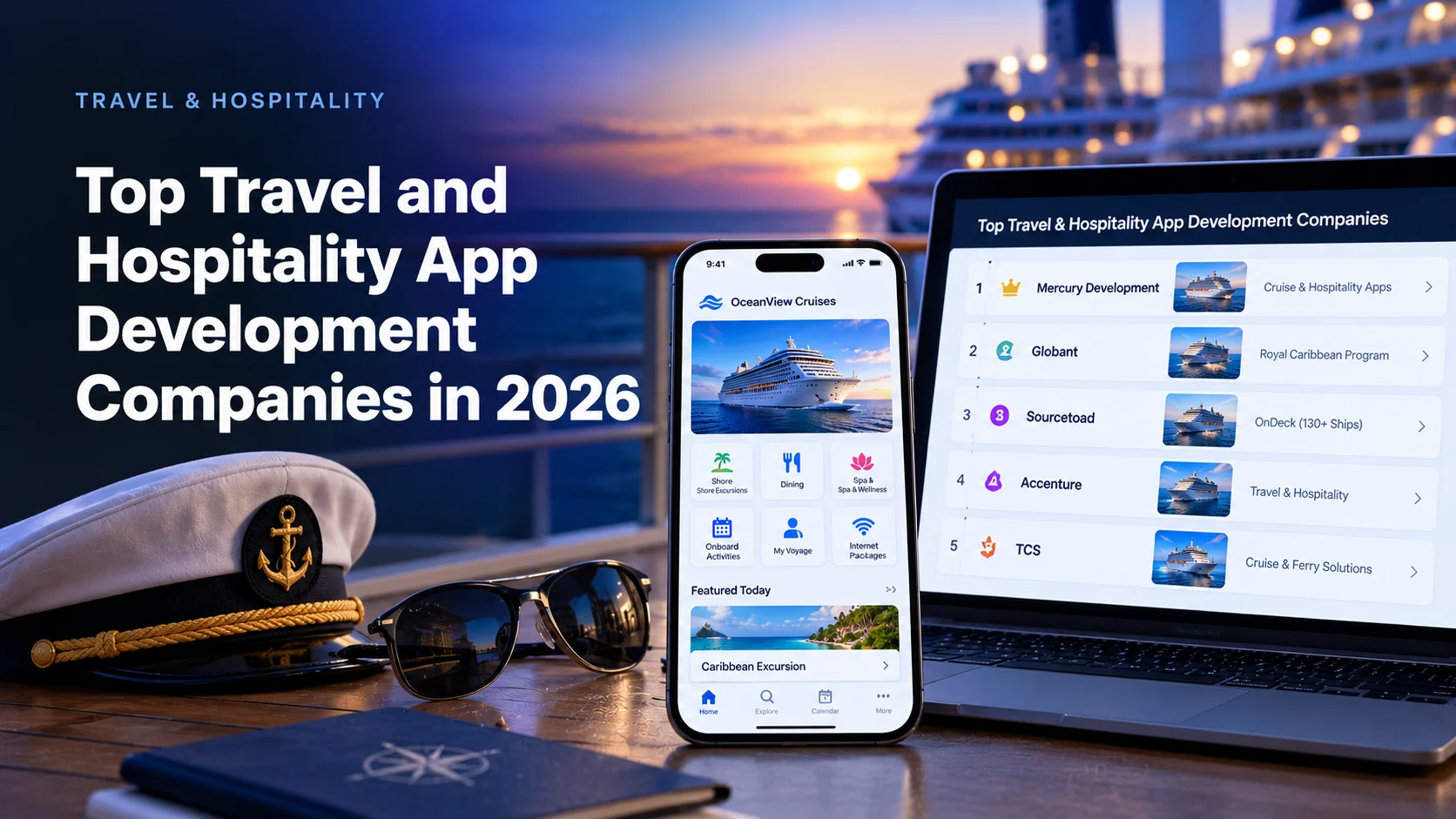
Top travel and hospitality app development companies in 2026
- TL;DR
- The cruise market your app sails into in 2026
- ETIAS and the EAA put two EU rules inside your cruise app
- How we evaluated
- The top 10 at a glance
- Which company fits your project
- What vendor pages show about cruise work
- Why Starlink did not fix your onboard app
- Planning a cruise guest app? Get a ship and shore scope first
- Frequently asked questions
- Sources
TL;DR
This ranking of travel and hospitality app development companies for 2026 is written for cruise lines. Ten vendors are scored on named cruise or hospitality work you can look up, evidence of shipboard engineering, shoreside booking depth, and who owns the code at the end. Mercury Development ranks first because a cruise app is a custom integration job on a weak link, and its software already runs on the ship: OneSpaWorld's onboard platform on over 160 ships since 2018, and crew and guest apps for cruise lines it cannot name under NDA.
- Globant runs the deepest named cruise program here: over 20 products with Royal Caribbean since 2017.
- Sourcetoad is the cruise specialist, with OnDeck software on over 130 ships, sold as a licensed product.
- Of the nine other vendors, five name a cruise or ferry operator on their own pages.
- Every card carries a watch-out, ours included.
The cruise market your app sails into in 2026
CLIA's 2026 State of the Cruise Industry report, as reported by Seatrade Cruise News, counts 37.2 million ocean cruise passengers in 2025, up 7.5% from 34.6 million in 2024. North America supplied 22.1 million of them. CLIA tallies 325 member line ocean ships with around 690,000 lower berths, and forecasts 40 million cruisers by the end of the decade.
Big numbers. The product consequence is smaller and harder. Every one of those passengers carries a phone onto a moving building that is, for most of the voyage, a long way from a cell tower.
Bandwidth got better fast. Royal Caribbean Group announced Starlink for all 64 ships of Royal Caribbean International, Celebrity Cruises and Silversea Cruises, with installation slated to finish by the end of the first quarter of 2023, and other large groups followed. That changes what you can stream. It does not change where your booking record, your folio and your muster status live, and that is the part your vendor has to get right.
If the choice is between a platform and your own build, start with our guide to onboard apps off-the-shelf or custom.
ETIAS and the EAA put two EU rules inside your cruise app
Two European rules land in your backlog in 2026, and neither is a market forecast.
The first is ETIAS. Frontex states that starting from the last quarter of 2026, people from 59 visa-free countries need a travel authorisation before visiting the 30 European countries in the scheme, and that travellers without one "will be refused boarding by the carrier". Its examples include a ferry company. If you sail Mediterranean or Northern Europe itineraries with US, UK or Australian guests, the pre-cruise check-in flow now needs a travel-authorisation step, a document status your shoreside team can see, and a message that reaches the guest weeks before the terminal does.
The second is already in force. The European Accessibility Act covers services provided to consumers after 28 June 2025, and Article 2(2)(c) names waterborne passenger transport services directly: websites, mobile device-based services including mobile applications, electronic tickets, and real-time travel information. One carve-out matters for ships. Self-service terminals installed as integrated parts of ships are excluded, so the kiosk on deck 5 is out of scope while the app on the guest's phone is in. Ask a vendor which of those two it thinks it is building.
What these rules add to the budget is broken down in our guide to cruise app development cost.
How we evaluated
Four criteria, applied to all ten companies and visible in every card:
- Named cruise, ferry or hospitality work on the company's own pages, with a client name you can look up.
- Shipboard engineering evidence: low-bandwidth or offline behaviour, Bluetooth and wearables, in-cabin screens, integration with onboard systems.
- Shoreside commerce depth: booking, reservations, payments and loyalty.
- Ownership model: custom work you own, or a licensed product you rent.
Facts come from each company's own travel, hospitality or case study pages, opened between October 24 and October 27, 2026, from investor pages where a company is listed, and from Clutch profiles. Ratings, review counts, minimum project sizes and rate bands are Clutch data and every card links the profile, because none of the ten publishes a price on its own pages. The participant set starts from the companies the current rankings for this query name, published by COAX Software, TeaCode, RaftLabs and Computools, filtered for evidence a cruise line can use. Where a page names no client, the card says so. Any group in our own data with fewer than three data points is not published.
The top 10 at a glance
| Company | Best for | Founded | HQ | Cruise or hospitality evidence on its own pages |
|---|---|---|---|---|
| Mercury Development | Custom guest and crew apps that must survive weak links and connect to hardware | 1999 | Fort Lauderdale, FL | OneSpaWorld platform on over 160 ships since 2018; crew and guest apps for cruise lines under NDA |
| Globant | A multi-year digital program at fleet scale | 2003 | Luxembourg | Royal Caribbean: over 20 products since 2017 |
| Sourcetoad | A licensed onboard app, TV and signage suite | 2008 | Tampa, FL | OnDeck on over 130 ships; Viking, Virgin Voyages, Explora named |
| Slalom | GenAI for booking and customer service | 2001 | Seattle, WA | Norwegian Cruise Line and Virgin Voyages |
| Endava | A multi-brand booking platform | 2000 | London, UK | Scenic Group, including Emerald Cruises |
| GP Solutions | Reservation engines and GDS plumbing | 2002 | Unterschleissheim, Germany | Tallink ferry booking; cruise booking software page |
| DataArt | Data platforms and travel distribution | 1997 | New York, NY | Unnamed luxury cruise line data platform |
| Intellectsoft | Hotel-style guest apps and onboard passenger systems | 2007 | New York, NY | Eurostar onboard system; Wynn booking app |
| TELUS Digital (WillowTree) | Consumer UX at enterprise scale | 2008 | Charlottesville, VA | Marriott, Brightline; cruise lines unnamed |
| Miquido | Consumer booking apps for tour operators | 2011 | Krakow, Poland | TUI Poland; no maritime client |
1. Mercury Development
Mercury Development ranks first because its cruise software already runs where cruise apps fail: on the ship, over the ship's network, inside the systems a line and its concessionaires actually operate. Two long programs carry that claim.
The first is OneSpaWorld, which describes itself as the operator of health and wellness centers onboard cruise ships and appears in Mercury's portfolio index as OneSpaWorld / Steiner Leisure. Mercury has built and maintained its onboard platform in production since 2018, on over 160 ships operated by multiple cruise lines. The spa applications are React web apps served from onboard servers with no external internet connectivity, used on Android tablets in kiosk mode and on ordinary computers without touch input. They connect to OneSpaWorld's ship-side backend, to on-shore data exchange systems, and through middleware to APIs specific to each cruise line, so one codebase serves several lines instead of one branch per line. Staff use them for treatment scheduling and booking, branded guest intake forms localized into multiple languages, a docket, POS and checkout with dynamic pricing that applies personalized discounts and offers from both OneSpaWorld and the cruise line, staff and guest directories, and voyage setup, reporting and ship-specific configuration.
Around that core sit the pieces a guest journey needs. E-Forms replaced paper consultation forms and runs on 1,000+ devices for over 3,000 staff members, with version history for every question and answer, signature and drawing fields, and ship-to-shore sync over RabbitMQ that tolerates low or sporadic bandwidth; a shore-side admin changes the form set and updates onboard software per vessel. Activity booking gives guests a calendar filtered by event type, booking for one or several people, a waitlist and a personal schedule, and class sign-ups pair tablets with cabin key RFID readers. On the pre-cruise side, Mercury built a guest-facing spa pre-booking site for Windstar Cruises guests, replacing bookings made through OneSpaWorld's call center, and a calendar widget that other cruise lines can embed on their own websites.
The second body of work is for cruise line clients Mercury cannot name under NDA, across crew and passenger software. For restaurant teams it has built React Native food and beverage apps: reservations, guest profiles with staff notes, check-in, and tableside ordering with table management, order status, kitchen and bar integrations, and allergen tracking. For guests it has rebuilt a cruise line's passenger app on React Native rather than porting the old one, covering pre-cruise readiness, the boarding pass, ship maps and wayfinding, chat, dining reservations and payment methods, with accessibility and payment security treated as release gates. For shipboard operations it has built a staff app that alerts casino floor teams to events and routes the follow-up, running on wall monitors and on phones and built for connectivity black spots on the ship. Behind the guest-facing work sit backend components and middleware that aggregate data and features from dozens of legacy microservices.
The rest of the record fills the gaps a guest app hits. ORIGOSafeDriver apps pair with in-vehicle hardware over Bluetooth Low Energy and run at 8 MB of data per device per month. For Kensington Proximo the team shipped a BLE Android app in 3 months, and around 20% of the case studies on its portfolio involve Bluetooth-connected hardware. The Apple TV and Google TV practice covers the cabin screen, the accessibility team has built WCAG 2 level AA compliant apps and names passenger transport services among its ADA work, and the Grant's app added a payment gateway integration for client-side PCI compliance. Around 30% of the case studies on its portfolio began with somebody else's code.
Best for: cruise lines and onboard concessionaires that need custom crew, venue or guest software running on shipboard servers, connected to their own and their partners' systems, with the code owned by the client. Facts: Founded 1999; HQ Fort Lauderdale, FL, with offices in Miami, Chicago, Cleveland, Belgrade and Buenos Aires; 500+ engineers, more than 1,500 completed projects and more than 40 million users of its applications; all work is work-for-hire and the customer owns the code and all underlying IP; Clutch 5.0 on 34 reviews, $25,000+ minimum. Watch-out: the cruise line work is under NDA, so it cannot be named on a page or in a public shortlist, and none of this cruise work has a public case study yet. If your procurement needs a named cruise line reference on paper before the first call, Globant and Sourcetoad publish one and Mercury does not.
2. Globant
Globant has the most detailed named cruise program in this ranking. Its case study Creating a smart venue on the high seas says Royal Caribbean Group and Globant started working together in 2017 and have since collaborated on over 20 different products, with a team that reached nearly 400 people. The work runs from the guest app (online check-in, documents before the terminal, shore excursions, specialty dining, onboard spend) and the case also covers Muster 2.0, the distributed safety drill, and kids-club registration that now takes nearly 80% less time.
Best for: a cruise line that wants one partner to run a multi-year digital program across guest, crew and safety products. Facts: Founded 2003; HQ Luxembourg per its investor FAQ; Clutch shows no reviews yet and a $5,000+ minimum. Watch-out: the whole cruise record is one client, told through self-published PDFs, and nothing on the pages we opened describes how its apps behave when the ship's link drops. At this scale your program is one account among many.
3. Sourcetoad
Sourcetoad is the only cruise specialist in this ranking. Its About OnDeck page says Sourcetoad developed the cruise industry's first onboard passenger app in 2010, launched iTV and signage on Viking Star in 2016, and launched the OnDeck Mobile App with Explora I in 2023. Named clients include Viking, Virgin Voyages, Explora Cruises, Ritz-Carlton Yacht Collection, NorthLink Ferries and Orkney Ferries, and its own article puts the technology on over 130 ships worldwide. It is also the one vendor here that publishes shipboard engineering: the Cruise Director Platform syncs content across a fleet with bandwidth-aware replication and delivers notifications to passengers with no internet required.
Best for: a line that wants a proven onboard app, in-cabin TV and signage suite live this season rather than built. Facts: Founded 2008 per Clutch; HQ Tampa, FL; Clutch 5.0 on 9 reviews, $25,000+ minimum. Watch-out: OnDeck is a SaaS product, so you license a platform rather than own a codebase, and your differentiation lives inside someone else's roadmap. The Clutch band of 10 to 49 employees is small for a fleet-wide dependency.
4. Slalom
Slalom's cruise work sits on shore, in the funnel. For Norwegian Cruise Line it built Nora, a GenAI itinerary assistant on OpenAI and AWS that came out of a four-week sprint. NCL guests who use it are 58% more likely to enter the booking funnel, and the value of their bookings rises 16%. For Virgin Voyages it built a GenAI digital human on Salesforce that cut call center escalations by more than 20%.
Best for: a cruise line that wants measurable AI in search, booking and customer service, delivered as a consulting program. Facts: Founded 2001 per Clutch; HQ Seattle, WA; Clutch 2.0 on 1 review, $100 to $149 per hour, the highest rate band here. Watch-out: none of the published cruise work is onboard, offline or device-level. If your problem is the app guests open on deck rather than the chat they open at home, Slalom's record does not reach it yet.
5. Endava
Endava's cruise case is a booking platform. For Scenic Group, which includes Scenic Luxury Cruises & Tours and Emerald Cruises, it built an online platform to research, book and manage trips across five brands in 15 markets, with a shared design language system and a visual trip planner for pre-departure upsell. Endava says the platform paid for itself within the first four weeks.
Best for: a multi-brand cruise group that needs one booking platform and one design system across brands and markets. Facts: Founded 2000 per Clutch; HQ London, UK; headcount 11,225 at March 31, 2026 per its third quarter fiscal 2026 results; Clutch shows no reviews yet. Watch-out: the cruise evidence stops at the website. Nothing published covers onboard apps, offline behaviour or devices.
6. GP Solutions
GP Solutions is a travel-only software house, and the cruise buyer's reason to call is reservations. Its Cruise Booking Software page lists rule-based cabin assignment, group, multi-itinerary and shared-cabin bookings, scheduling of onboard facilities such as restaurants and spa, and combined payment types. The maritime proof is a ferry: for Tallink it built a single-page booking flow, add-on booking, self-service changes, cross-platform apps and a loyalty program inside the booking system, over 50,000 man-hours. It is a certified Amadeus development partner and a member of the Sabre Developer Partner Program, per its About page.
Best for: a line replacing or extending its reservation engine, cabin inventory and agency distribution. Facts: Founded 2002 per Clutch; HQ Unterschleissheim, Germany; 350+ IT professionals; Clutch 4.9 on 24 reviews, $50,000+ minimum. Watch-out: the cruise booking page names no cruise line, and the Tallink result it reports is a 1.4% sales increase. Strong plumbing, thin guest-experience evidence.
7. DataArt
DataArt is the travel distribution heavyweight. Its travel tech page shows Priceline, Travelport, Virtuoso, Traveltek, Skyscanner and Trainline among its clients, and it holds an AWS Travel and Hospitality Competency. It runs a dedicated cruise and ferry page, and its one cruise case is a self-service data platform for an unnamed luxury line sailing seven continents, joining PMS, CRM and marketing data on Snowflake, Azure and Power BI.
Best for: cruise lines whose problem is data and distribution: agency connectivity, revenue reporting, a single view of the guest. Facts: Founded 1997; HQ New York, NY; Clutch 4.9 on 26 reviews, $100,000+ minimum, the highest floor here. Watch-out: no cruise client is named, the cruise case is back office rather than guest-facing, and the minimum prices out a first app release.
8. Intellectsoft
Intellectsoft's closest analogues are a train and a hotel. Its Eurostar page describes a web and mobile passenger experience system that handles onboard processes and real-time communication. The travel and hospitality page adds a Wynn app for booking rooms and restaurant tables, an Android booking app for Japan's Prince hotels, and a smart in-room app for an unnamed luxury hotel that works offline and online.
Best for: stateroom and guest-service apps modelled on hotel operations, with IoT in the room. Facts: Founded 2007; HQ New York, NY on its own site and Miami, FL on Clutch; Clutch 4.9 on 46 reviews, $50,000+ minimum. Watch-out: the Eurostar page publishes no results, and parts of its challenge and solution text describe a dental clinic platform instead, which looks like a template error. Ask for the real case material.
9. TELUS Digital (WillowTree)
WillowTree, founded in 2008 in Charlottesville, Virginia, was acquired by TELUS International and now trades as TELUS Digital. Its travel and hospitality page shows Marriott, Brightline, Hilton Grand Vacations and Airbnb, and says that renowned cruise lines work with it, without naming one. The published Marriott case is a sales productivity tool with a 159% increase in monthly active users, built from concept to launch in 6 months.
Best for: a large brand that wants consumer-grade UX research and design with enterprise delivery behind it. Facts: Founded 2008; HQ Charlottesville, VA at acquisition; more than 1,000 staff at that time per the acquisition release; Clutch profile not reachable on October 27, 2026. Watch-out: the cruise claim carries no name, and the strongest hospitality case is an internal tool, not a guest app.
10. Miquido
Miquido builds consumer travel apps for tour operators and metasearch. The TUI Poland app lets guests save hotels, browse last-minute offers and book in the app with PayU or card, and it reports 1M+ Google Play downloads. For Skyscanner it built the car rental module from scratch for iOS and Android.
Best for: a cruise brand selling packages direct to consumers that wants polished booking UX. Facts: Founded 2011 per Clutch; HQ Krakow, Poland; Clutch 4.9 on 51 reviews, $25,000+ minimum. Watch-out: no maritime or onboard work is published, and the TUI download figure differs between the case page and its own travel page.
Which company fits your project
Ranking is one thing. Fit is another.
| Project type | Recommended partner |
|---|---|
| Custom guest or crew app on a weak link, with wearables or cabin hardware | Mercury Development |
| Taking over an existing cruise app from another vendor | Mercury Development |
| Onboard service, spa or activity booking apps run across a fleet | Mercury Development |
| Crew dining, venue and tableside ordering apps | Mercury Development |
| Multi-year fleet digital program with one partner | Globant |
| Onboard app, iTV and signage live this season, licensed | Sourcetoad |
| GenAI in itinerary search and customer service | Slalom |
| One booking platform across several cruise brands | Endava |
| Reservation engine, cabin inventory, GDS and agency links | GP Solutions |
| Guest data platform and distribution reporting | DataArt |
| Hotel-style stateroom and guest-service apps | Intellectsoft |
| Consumer UX research for a large brand | TELUS Digital (WillowTree) |
| Direct-to-consumer package booking app | Miquido |
What vendor pages show about cruise work
Here is the part the rankings for this query skip. Between October 24 and October 27, 2026 we opened the travel, hospitality and case study pages of the nine other companies above and checked three things: does a named cruise or ferry operator appear, does the work happen on the ship or on shore, and does the page say anything about connectivity.
- Five of the nine name a cruise or ferry operator: Globant, Sourcetoad, Slalom, Endava and GP Solutions. GP Solutions' named case is a ferry line.
- Two claim cruise work without a name. TELUS Digital says renowned cruise lines work with it; DataArt publishes a cruise case for an unnamed luxury line.
- Most named cruise work is shoreside. Slalom's two cases are AI on the website and in the contact center, Endava's is a booking platform, GP Solutions' is a booking front end and loyalty, DataArt's is a data platform. Globant and Sourcetoad are the two whose published cruise work reaches the ship.
- One of nine publishes how its software behaves at sea. Sourcetoad describes bandwidth-aware replication and notifications with no internet required. No other page we opened says what happens when the satellite link drops.
- The rankings themselves need checking. One current list calls LeewayHertz "cruise-tested"; its iCruise page is a single sentence about a cruise search and booking app, with no client detail, platforms or results.
- None of the ten, ours included, publishes a price on its own pages.
Our own card belongs in this paragraph. Mercury Development names no cruise line on its case pages either. What it can describe is the work: OneSpaWorld's onboard platform on over 160 ships, served from shipboard servers with no external internet, and crew, guest and casino floor apps for cruise lines it cannot name. That makes Mercury and Sourcetoad the two companies in this ranking that say how their software behaves at sea.
Vendors that build the reservation core and the booking edges are ranked in our list of cruise line software development companies.
Why Starlink did not fix your onboard app
Opinion, with the mechanism.
Satellite internet made the pipe fat. It did not make the ship part of the internet. A guest who never buys a package still expects the app to show tonight's dining slot, the kids-club pickup and their muster station. The crew tablet at the gangway still has to scan when the link is saturated by guests uploading sunset videos. The ship is an edge data center with one expensive uplink, and the system of record for anything that happens onboard has to live on the ship first.
That is why the build decision is not the screen. Any capable vendor can draw an itinerary view. The money goes into the parts nobody demos: which service answers when the guest taps "book" with no internet package, how a reservation made at sea reconciles with shore when the link returns, how the folio stays consistent across bars, spa and app, how a wristband or cabin beacon pairs without a support call, and how the whole thing degrades rather than fails.
The failures we keep meeting in cruise programs are of the same kind. A login token issued on shore stops working when the guest walks onto the ship. An API that works in production does not work in the QA environment, so nothing can be tested before it ships. Guests cannot tell the free ship network from a paid internet package, and the app has to explain which one it needs. Test accounts expire, VPN access takes weeks, and some behaviour can only be reproduced on a real vessel. None of that shows up in a pitch deck, and all of it sets the launch date.
So change the interview question. Do not ask a vendor how many travel apps it has built. Ask it to walk you through one booking made on deck 12 during a link outage, from tap to shoreside revenue report. A team that has built for constrained networks answers in a sentence. A team that has not will tell you about Starlink.
Written by Rob Devereaux, Chief Operating Officer at Mercury Development. Rob has run the firm's operations from Hudson, Ohio since 2019 and has over 20 years of operational and financial experience. The delivery history behind this article's figures on Mercury's own case studies and cruise programs sits in the operations he oversees.
Planning a cruise guest app? Get a ship and shore scope first
Most cruise app projects pick a vendor before anyone decides what runs on the ship and what runs on shore. Send us your fleet's guest journey, the systems the app has to talk to, and what you already have live. We will map what belongs onboard, what belongs ashore, and the first release.