
Travel app design agencies for cruise and maritime products in 2026
TL;DR
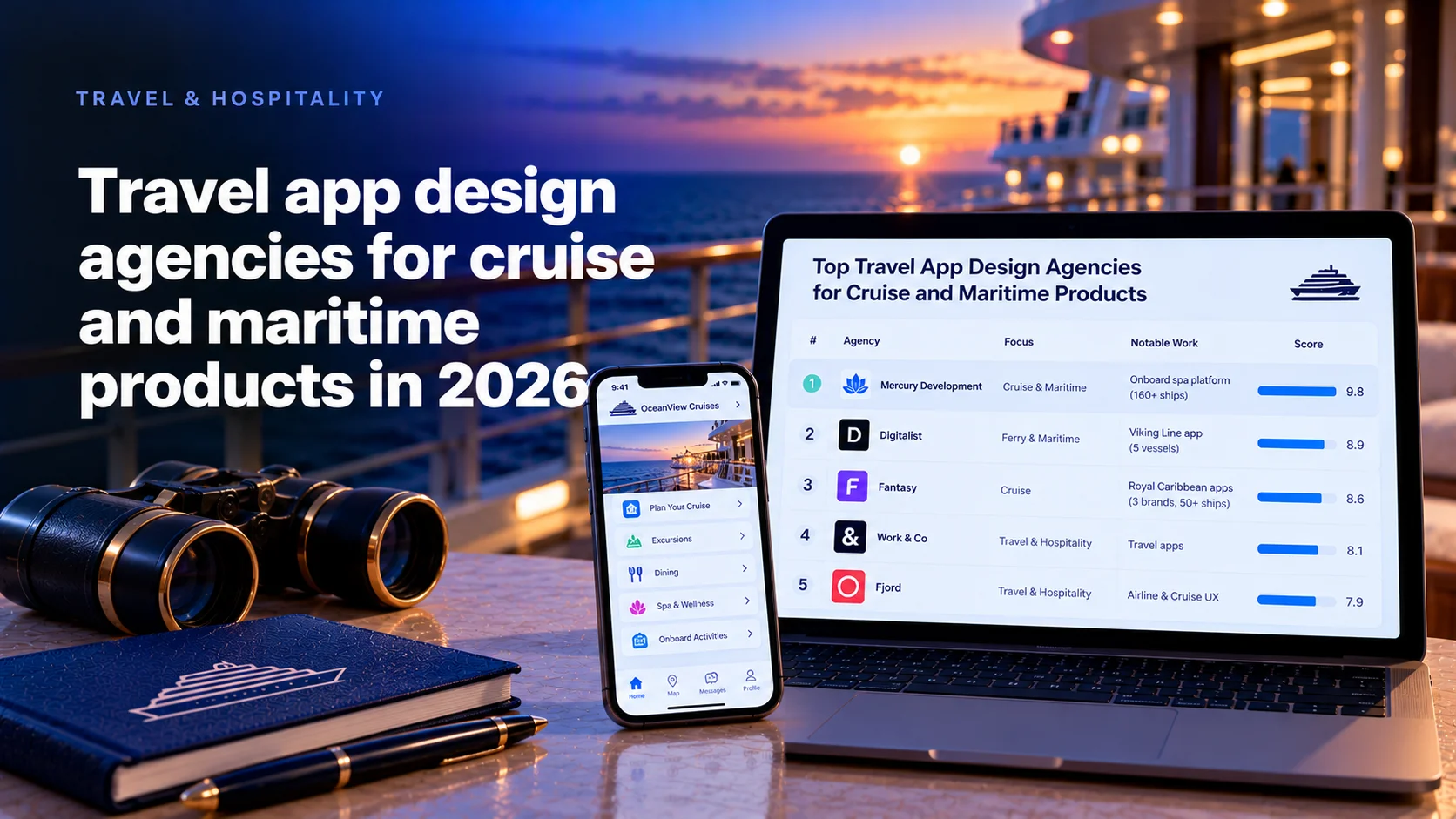
This ranking of travel app design agencies for 2026 is written for cruise lines and ferry operators. Ten agencies are scored on named cruise, ferry or airline design work, evidence that their screens survive a ship's network, accessibility practice, and whether one team designs and builds. Mercury Development ranks first because its interfaces already run at sea: OneSpaWorld's onboard platform on over 160 ships since 2018, used on kiosk-mode tablets, plus guest and crew app redesigns for cruise lines it cannot name under NDA.
- Digitalist designed and built Viking Line's onboard app, launched in 2015, with a local server on each of five vessels.
- Fantasy's Royal Caribbean work spans the app, stateroom TV and crew tools across 3 brands and 50+ ships.
- Four of the nine other agencies publish named cruise or ferry design work. One explains how its design works without a connection.
- Every card carries a watch-out, ours included.
Why cruise apps keep failing design reviews
CLIA counted 37.2 million ocean cruise passengers in 2025, up 7.5% from 34.6 million in 2024, as reported by Seatrade Cruise News. North America supplied 22.1 million of them, and CLIA forecasts 40 million cruisers by the end of the decade. Most of those guests meet your brand in an app weeks before they see the ship.
The app is also where they lose patience. In September 2024 a travel agent told Virgin Voyages chief executive Nirmal Saverimuttu "Your app sucks!", and he answered "I 100% agree", Travel Weekly reported. He called the app unstable, with a weak user interface, and compared booking a dinner table to playing The Hunger Games.
That is a design failure with an engineering root. A cruise guest app runs on a moving building with a paid satellite link, a free ship network, dozens of backend systems and an audience that skews older. Screens that pass a design review on shore break on the gangway. The agency you hire for design has to know what the ship does to every state of every screen.
What each screen should say on free ship Wi-Fi is covered in our guide to the cruise app without internet package.
Apple's SDK rule and the EAA put design on your 2026 roadmap
Two rules turn design from polish into release work.
The first is Apple's. Since April 28, 2026, apps uploaded to App Store Connect must be built with Xcode 26 and the iOS 26 SDK. That SDK brings Liquid Glass, Apple's new design language, and teams that were not ready used the temporary UIDesignRequiresCompatibility key to keep the old look, as Classmethod's iOS 27 guide explains. An Apple engineer confirmed on the developer forums that the system ignores this key once an app is linked against the iOS 27 SDK. Apple has not announced when that SDK becomes mandatory. Your guest app needs a tested Liquid Glass version before it does.
The second is European. The European Accessibility Act covers services provided to consumers after 28 June 2025, and Article 2(2)(c) names waterborne passenger transport services, including websites and mobile applications. WCAG 2.2 sets a minimum target size of 24 by 24 CSS pixels at level AA, and another AA criterion requires text to resize up to 200 percent without loss of content. On a guest app full of deck maps and dense daily programs, those two rules shape the layout before the brand book does.
How the current cruise apps handle accessibility today is shown in our cruise mobile apps report.
How we evaluated
Four criteria, applied to all ten agencies and visible in every card:
- Named cruise, ferry or airline design work on the agency's own pages, with a client you can look up.
- Evidence that the design works at sea: offline and low-bandwidth states, onboard networks, tablets, kiosks and cabin screens.
- Accessibility practice that names a standard.
- Design and build under one roof, and who owns the result.
Facts come from each agency's own case study and service pages, opened on October 28 and 29, 2026, from investor and acquisition releases, and from Clutch profiles. Ratings, review counts, minimum project sizes and rate bands are Clutch data, and every card links the profile. The starting set is the pages that surface for this query, including Fuselab Creative's travel design page, Exoft's UI/UX services and the Clutch list of top UX designers for IT services, widened with agencies that publish named cruise, ferry or airline work. Any group in our own data with fewer than three data points is not published.
The top 10 at a glance
| Company | Best for | Founded | HQ | Named travel or maritime design work |
|---|---|---|---|---|
| Mercury Development | Guest, crew and onboard staff UI on a ship's network | 1999 | Fort Lauderdale, FL | OneSpaWorld onboard platform on over 160 ships; cruise guest and crew apps under NDA |
| Digitalist | Ferry passenger apps with onboard content | Not stated | Finland | Viking Line app since 2015; Color Line app |
| Fantasy | One design language across a fleet app ecosystem | 1999 | New York, NY | Royal Caribbean app, stateroom TV and crew tools |
| Infinum | Pier, terminal and check-in tools | 2005 | New York, NY | Royal Caribbean check-in, by its ETR team |
| Monstarlab | Conversion work on cruise booking flows | 2006 | Tokyo, Japan | Virgin Voyages booking site |
| Work & Co | Booking site and apps designed and built together | 2013 | Brooklyn, NY | Virgin America site and apps |
| Revelex | Booking UI on a cruise distribution engine | 1999 | Boca Raton, FL | No client named on its UX page |
| Fuselab Creative | Map-heavy travel UI with research | 2017 | McLean, VA | GeoTourist, Uber; no cruise client |
| Qubstudio | Mobile UX redesigns and design systems | 2006 | Lviv, Ukraine | EV charging app; no travel client |
| Exoft | Design attached to an outsourced build | 2013 | Lviv, Ukraine | No travel case published |
1. Mercury Development
Mercury Development ranks first because its interfaces already work where cruise apps break: on shipboard servers, on shared tablets in kiosk mode, and on guest phones that move between the free ship network and paid internet. Design runs inside its engineering engagements, so a screen is drawn by people who know which service answers it. Two cruise programs carry the claim.
For OneSpaWorld, which appears in Mercury's portfolio index as OneSpaWorld / Steiner Leisure, Mercury has built and maintained the onboard spa platform in production since 2018, on over 160 ships operated by multiple cruise lines. The interfaces are React web apps served from onboard servers with no external internet. Staff use them on Android tablets in kiosk mode and on ordinary computers without touch input, so every screen works for a finger and a mouse. Guest intake forms are branded and localized into several languages. The E-Forms layer adds signature and drawing fields, visibility and highlighting rules, and version history for every question, synced over low or sporadic bandwidth on 1,000+ devices for over 3,000 staff members. One codebase serves several cruise lines instead of one branch per line.
For cruise line clients Mercury cannot name under NDA, it has delivered a refreshed UI/UX with new aggregating middleware for passenger apps, rebuilt a guest app on React Native instead of porting the old one, and built React Native dining and tableside ordering apps for restaurant teams. Accessibility and payment security were release gates. A staff app for casino floor teams runs on wall monitors and phones and is designed for connectivity black spots on the ship.
Outside cruise, the accessibility team has built WCAG 2 level AA compliant mobile and web apps and lists passenger transport services among its ADA work. For Shots, designers reworked an existing app's interface for wrist-worn control. For Distiller, a complete visual redesign of the catalogue, reviews, lists and community screens was defined before engineering started.
Best for: cruise lines and onboard concessionaires that need guest, crew or venue interfaces designed and built by one team, tested against shipboard servers and weak links. Facts: Founded 1999; HQ Fort Lauderdale, FL; 500+ engineers, more than 1,500 completed projects and more than 40 million users of its applications; all work is work-for-hire and the customer owns the code and all underlying IP; Clutch 5.0 on 34 reviews, $25,000+ minimum, $50 to $99 per hour. Watch-out: Mercury is an engineering company with design inside it, not a brand studio, and none of its cruise work has a public case study with screens. If you need a visual identity and an award reel before the first call, Fantasy and Work & Co show more.
2. Digitalist
Digitalist has the longest published maritime design record here. It has worked with Viking Line on digital services since 2013, starting from interviews, workshops and focus groups with passengers and staff. The Viking Line app launched in 2015, and a few days later it was the number one travel app in Finland. The work reaches the ship: a React Native service portal for onboard services, check-in, electronic boarding passes and mobile cabin keys, plus a local CMS server on each of five vessels that synchronizes when the ship docks and feeds the app, cabin TVs and signage without a continuous internet connection. For Color Line, it designed a passenger app as the hub for onboard services and ancillary purchases, on React Native, Drupal and AWS.
Best for: ferry and short-cruise operators that want passenger research, app design and an onboard content platform from one team. Facts: 20+ years of delivery and 40+ senior experts per its site; Digitalist Group had 118 employees at the end of 2025 per its financial statement release; based in Finland; no Clutch data used. Watch-out: the record is Nordic ferries, and the Color Line page reports no results. Ask who staffs your account across time zones.
3. Fantasy
Fantasy, an independent New York agency founded in 1999 per its LBB profile, publishes the most detailed cruise UX redesign in this ranking. Its Royal Caribbean page makes the app the core of a connected set of onboard touchpoints, unifying 3 global brands across 50+ ships: booking and planning, dining and show reservations, stateroom controls and mobile keys, location-aware drink ordering, facial-recognition check-in, stateroom television, crew tools and executive dashboards. Fantasy reports a 22% increase in onboard WiFi sales, a 45% increase in onboard reservations for shore excursions and dining, and a 4.8 average app rating.
Best for: a cruise group that wants one design language across brands, app, stateroom TV and crew tools. Facts: Founded 1999; HQ New York, NY; Clutch shows no reviews yet and 50 to 249 employees. Watch-out: the page gives no project dates and does not say who wrote the code. Nothing published describes how the screens behave when the ship's link drops.
4. Infinum
Infinum's cruise work sits at the pier. Its Royal Caribbean case, delivered by the ETR team that Infinum acquired in 2023, is a check-in application that lets passengers check in up to two days before sailing. Pier agents get a tablet tool that recognizes groups, works in multiple languages and escalates special requests. The team ran a few weeks of field research at ports in Miami, prototyped early, and moved from iOS to Microsoft Surface tablets for battery life and scanner and printer support. Infinum reports a 110% increase in users and says lines and wait times were effectively cut in half on the first sailing.
Best for: terminal, check-in and crew-facing tools that need field research with staff. Facts: Founded 2005; HQ New York, NY per Clutch; Clutch 4.8 on 58 reviews, $50,000+ minimum, $150 to $199 per hour, the highest rate band here. Watch-out: the case lists strategy, UX and UI design, not development, and it is undated. ETR was a team of 24 when acquired, so ask whether the people behind the case still work on cruise accounts.
5. Monstarlab
Monstarlab's cruise case is conversion design on shore. Mobile booking rates at Virgin Voyages sat below 1% despite more traffic than desktop. Monstarlab ran research, benchmarking and A/B tests, redesigned the booking flow against a three-month deadline before peak season, and trained the client's staff to run their own user testing. After launch, mobile bookings rose by up to 5.7% and desktop bookings by up to 6%, with a projected $20 million annual revenue impact.
Best for: a cruise line whose booking funnel loses mobile visitors. Facts: Founded 2006; HQ Tokyo, Japan; Clutch 4.8 on 9 reviews, $100,000+ minimum, the highest floor here. Watch-out: the work is a website, not the guest app or anything onboard, and the revenue figure is a projection.
6. Work & Co
Work & Co's travel record is an airline, and it is the strongest airline case in this list. As Virgin America's digital agency of record, it designed and built the airline industry's first responsive website, then native iOS and Android apps, and cut homepage clutter so travelers could book a flight in about 60 seconds. It reports a 3x increase in mobile conversion with the app, page loads under 2 seconds, and a 20% decrease in web-related support calls. Accenture completed its acquisition of Work & Co in January 2024, adding nearly 400 people to Accenture Song.
Best for: a booking site and app rebuilt together by one design and engineering team. Facts: Founded 2013; HQ Brooklyn, NY; Clutch shows no reviews yet, $5,000+ minimum, $100 to $149 per hour. Watch-out: the case predates Virgin America's 2018 acquisition by Alaska Airlines, no maritime work is published, and you now buy through Accenture Song.
7. Revelex
Revelex is a cruise distribution company that also sells design. Founded in 1999 in Boca Raton, it released a cruise booking engine in 2001, Cruise Mobile in 2012 and a Cruise API in 2020, per its company history. Its UX/UI design service promises visually enhanced deck maps, itinerary builders and payment integration, with four stages from discovery to testing. In 2024 Windstar Cruises called Revelex its first booking-engine partner, listing its cruises next to inventory from 40+ major cruise lines.
Best for: cruise lines and travel sellers that want booking UI designed by the team that runs the booking engine. Facts: Founded 1999; HQ Boca Raton, FL; Clutch profile not reachable on October 29, 2026. Watch-out: the UX page names no client and shows no screens or results, and the design work is tied to Revelex's own platform. No onboard or guest app work is published.
8. Fuselab Creative
Fuselab Creative is a Washington, D.C. area design agency with a dedicated travel app and website design page. It describes a six-stage design process, tags GeoTourist and Uber as travel portfolio work, and lists map visualization and dashboard interfaces among its design specialties. Engineering services sit next to design, from MVP development to wearables.
Best for: research-led UI for travel products with maps and data-heavy screens. Facts: Founded 2017 per Clutch; HQ McLean, VA; Clutch 5.0 on 15 reviews, $25,000+ minimum, $100 to $149 per hour. Watch-out: no cruise, ferry, airline or hospitality client is named, and the travel page has no FAQ and no results. A Clutch band of 10 to 49 employees is small for a fleet program.
9. Qubstudio
Qubstudio is a mobile UX studio with the most Clutch reviews in this ranking. Its mobile app design page shows redesigns for ila Bank and Gulf Bank of Kuwait, where it reports a 2x higher App Store rating and a 78% increase in users, plus Go TO-U, an EV charging app rated 4.9 on 5,000+ reviews. It claims 700+ delivered projects.
Best for: a redesign of an existing mobile app with a new design system and onboarding. Facts: Founded 2006 per Clutch; HQ Lviv, Ukraine, with a London office; Clutch 4.9 on 93 reviews, $10,000+ minimum, $50 to $99 per hour. Watch-out: no travel, hospitality or maritime work is published, and none of the visible Clutch reviews comes from those sectors.
10. Exoft
Exoft sells UI/UX design as part of a software development company. Its UI/UX design services page lists product, mobile and web design, prototyping and UX audits, and says it has designed for more than 500 companies. The named mobile case is a banking app for PCN Bank.
Best for: a build partner that also covers design at a lower rate. Facts: Founded 2013; HQ Lviv, Ukraine; Clutch 4.8 on 44 reviews, $10,000+ minimum, $25 to $49 per hour, the lowest rate band here. Watch-out: no travel or maritime case is published, TripLV appears only as a logo, and the page has no FAQ.
Which agency fits your project
Ranking is one question. Fit is another.
| Project type | Recommended partner |
|---|---|
| Guest or crew app that must work on the ship's network | Mercury Development |
| Onboard spa, venue or service tablets in kiosk mode | Mercury Development |
| Redesign of a live cruise app on a new stack | Mercury Development |
| Ferry or short-cruise passenger app with onboard content | Digitalist |
| One design language across brands, app and stateroom TV | Fantasy |
| Pier, terminal and check-in tools | Infinum |
| Mobile booking conversion on the website | Monstarlab |
| Booking site and app rebuilt together | Work & Co |
| Booking UI on a cruise distribution engine | Revelex |
| Map-heavy travel UI with research | Fuselab Creative |
| Mobile UX redesign and design system | Qubstudio |
| Design bundled into a low-rate outsourced build | Exoft |
For the development side of the same decision, see our ranking of travel and hospitality app development companies.
What agency pages show about ship-ready design
On October 28 and 29, 2026 we opened the case and service pages of the nine other agencies and checked three things: a named cruise or ferry client, design work that reaches the ship, and anything about connectivity.
- Four of the nine publish named cruise or ferry design work: Digitalist, Fantasy, Infinum and Monstarlab. Work & Co adds an airline.
- One of the nine explains how its design works without a continuous connection: Digitalist, through local servers on Viking Line's five vessels.
- Most named cruise work stays on shore or at the pier. Monstarlab's is a booking site and Infinum's is check-in, while Revelex ties its design service to booking. Fantasy and Digitalist are the two whose published work reaches the stateroom and the deck.
- Headlines need checking. A case study aggregator says Royal Caribbean launched a cruise planner with Brave People, while the agency's own page describes a design bake-off proposal and a clickable prototype, and does not say it was built.
- None of the three pages that surface first for this query has an FAQ.
What our own case studies say about design and build
We ran the same check on our own published case studies.
- Around 70% describe design work next to the engineering: UI prototypes, redesigns, illustration, brand identity or platform-specific layouts.
- Around 30% name design in the page title.
- Around 35% of those design projects started from an app or product already in users' hands: a published app taken over, a legacy product redesigned, or another studio's design reworked to pass App Store review.
- Around 30% of all the case studies began with somebody else's code.
The last two numbers matter most for a cruise line. A cruise app redesign usually starts from a live app with live bookings in it, and the design team has to work around data and services it cannot pause.
Why a ship app is designed from the network up
Opinion, with the mechanism.
A screen on a ship has more states than a screen on land. Offline. On the free ship network without internet. On a paid package. Back on shore with a session issued at sea. Each state needs its own copy, its own empty state and its own way out, and most cruise app failures we are asked to fix live in the states nobody drew.
The patterns repeat across the cruise programs we work on. Guests cannot tell the free ship network from a paid internet package, so the app has to say which one a feature needs. A login issued on shore stops working on the gangway. Feedback from a real sailing flagged navigation buttons that guests missed because the tap area was too small. Deck maps with text baked into images cannot be resized for accessibility or corrected without a new asset. When every module was designed by a different team in a different year, guests feel it: each screen reads like a different app. And some of this can only be reproduced on a real vessel.
A better mood board fixes none of it. A designer who sits with the engineers who know the ship, tests on board and treats connectivity as a design input does. So when you interview agencies, skip the reel for the first ten minutes. Ask them to draw the dining reservation screen for a guest with no internet package, then the same screen when the reservation service is down. A team that has designed for ships draws several screens. A team that has not draws one.
Written by Rob Devereaux, Chief Operating Officer at Mercury Development. Rob has run the firm's operations from Hudson, Ohio since 2019 and has over 20 years of operational and financial experience. The delivery records behind this article's figures on Mercury's own case studies and cruise programs sit in the operations he oversees.
Planning a cruise app redesign? Map the ship states first
Most cruise app redesigns start with screens and discover the ship later. Send us your current app, the systems behind it and the journeys guests complain about. We will map every screen against the ship's network states, flag what breaks at sea, and outline a first release your design and engineering teams can ship together.